

Start at 1:15 by weight for French press coffee, using the standard ratio of one gram of coffee for every 15 grams of water. That’s your baseline, and it works across roasts and press sizes. If your cup tastes flat, nudge toward 1:12; if it tastes sharp or bitter, ease back toward 1:17. Measure with a kitchen scale when you can, steep four minutes, and pour off every last drop the moment the timer stops.
TL;DR:
- Using a 1:15 ratio of coffee to water is the standard starting point, but adjusting to 1:12 or 1:17 can fine-tune strength and flavor preferences.
- Measuring coffee by weight provides more consistency than volume, with about 5 to 6 grams per tablespoon of coarse grounds for accuracy.
- Proper grind size, steep time, and water temperature are critical to avoid bitterness, weakness, or mud in the cup, with four minutes steeping at 195°F to 205°F as a baseline.
- Small ratio adjustments of 2 to 3 grams per serving can significantly alter flavor, so change only one variable at a time and allow palate calibration.
- A reliable kitchen scale and a well-designed press with a tight filter are recommended tools to achieve consistent, optimal French press coffee.
Table of Contents
- What Is the Best French Press Coffee Ratio by Press Size?
- How Do I Measure French Press Coffee Without a Scale?
- Why Do Grind, Time, and Temperature Matter as Much as Ratio?
- What Does 1:12 vs. 1:15 vs. 1:17 French Press Taste Like?
- Why Is My French Press Coffee Bitter, Weak, or Muddy?
- An Editor’s Take on Getting French Press Ratio Right
- Gear That Makes Hitting Your Ratio Effortless
- Sources
- FAQ
What Is the Best French Press Coffee Ratio by Press Size?
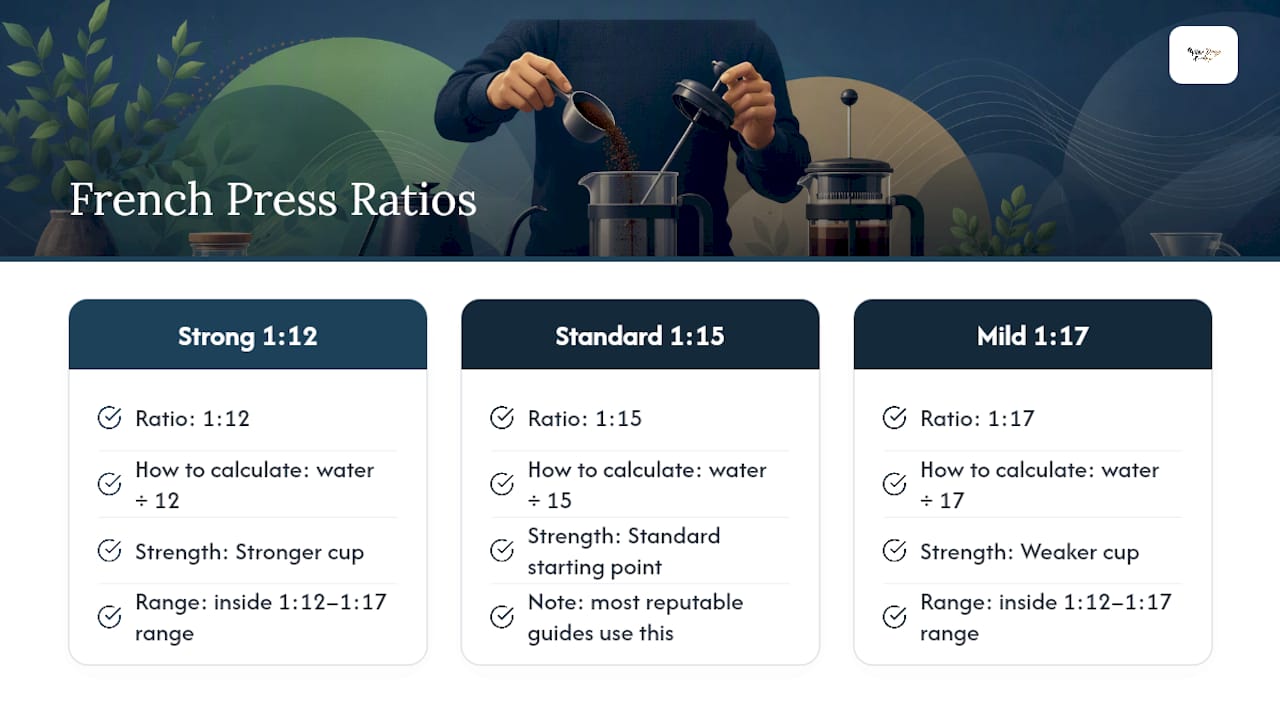
The 1:15 ratio (one gram of coffee for every 15 grams of water) is the standard starting point that most reputable brewing guides land on, with a workable range from 1:12 to 1:17 depending on how strong you like your cup. Grams beat volume here because coffee beans vary in density. A tablespoon of light roast weighs less than a tablespoon of dark roast, so weight is the only measurement that stays consistent brew after brew.
Here’s how that plays out across the presses most home cooks actually own:
Scaling up or down from any of these is simple arithmetic: divide your water weight by 15 (or 12, or 17) to get your coffee weight, then adjust from there. A calculator that lets you punch in your press volume and preferred strength setting takes the guesswork out entirely, which is worth bookmarking if you rotate between multiple press sizes.
No scale handy? Rough tablespoon conversions get you close: about 2 level tablespoons of coarse grounds per 6 ounces of water gets you in the neighborhood of 1:15, though grind size and roast will shift that slightly every time.
How Do I Measure French Press Coffee Without a Scale?
A scale gives you the most consistent cup, but plenty of great coffee gets brewed with nothing more than a tablespoon and a good memory. Here’s what to keep in mind if you’re going by volume instead of weight.
- One tablespoon of coarse coffee grounds weighs roughly 5 to 6 grams, though oilier dark roasts run heavier.
- For a 12 oz press, that’s about 4 level tablespoons to land near 1:15.
- For a 32 oz press, aim for 10 to 11 tablespoons, then taste and adjust on your next brew.
- Use the same scoop every time. Consistency matters more than hitting a perfect number.
Pro Tip: Buy an inexpensive kitchen scale once, weigh your favorite scoop of grounds, and write the gram number on a sticky note by your coffee canister. You’ll have scale-level precision using nothing but your regular scoop from then on.
Why Do Grind, Time, and Temperature Matter as Much as Ratio?
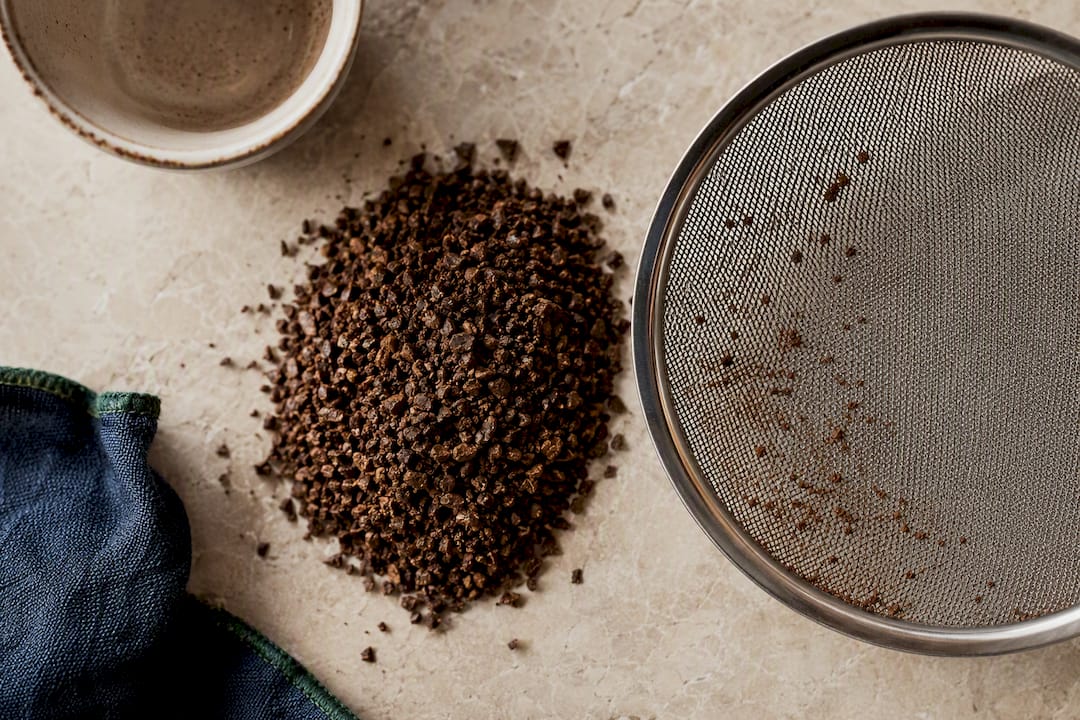
Ratio sets the framework, but grind size, steep time, and water temperature decide whether that framework actually delivers a balanced cup. French press is a full-immersion method, so grounds sit in contact with water the entire brew. That makes coarse, even grounds essential. Fine particles slip through the mesh filter and turn your cup gritty, while inconsistent grind sizes extract unevenly, pulling sourness from the fine bits and under-extraction from the coarse ones.
Four minutes is the standard steep time reviewers and brewing guides consistently recommend, and it pairs naturally with a coarse grind. Water temperature should sit between 195°F and 205°F, just off a rolling boil. Cooler water under-extracts and tastes thin; hotter water pulls out excess bitterness fast.
Coffee typically extracts best around 19 to 22 percent of its soluble solids; cross past that, even by a percentage point or two, and bitterness takes over. That’s why small changes matter so much in this method.
- Grind coarser or finer to fix texture and clarity issues.
- Adjust ratio or time to fix strength issues.
- Change only one variable per brew so you know what actually moved the needle.
What Does 1:12 vs. 1:15 vs. 1:17 French Press Taste Like?
Every ratio on the spectrum has a job. Picking the right one comes down to what roast you’re using and what kind of cup you want.
- 1:12 (strong). Heavy body, bold and syrupy, closer to a concentrate. Works well for dark roasts you plan to cut with milk, or for anyone who wants a French press “shot” to build an iced latte on.
- 1:15 (balanced). This is the sweet spot most guides default to for good reason: enough body to feel substantial, enough clarity to taste roast character without muddiness.
- 1:17 (light). Delicate and tea-like, letting single-origin or lighter roasts show their acidity and aromatics without heaviness.
Small adjustments beat big overhauls. Try shifting just 2 to 3 grams of coffee per serving before you jump a full ratio step. Give your palate a day or two to calibrate before deciding a change didn’t work.
Why Is My French Press Coffee Bitter, Weak, or Muddy?
Most French press problems trace back to one of three culprits, and each has a specific fix rather than a guess-and-check redo of your whole recipe.
- Bitter: Decant immediately, don’t let the pot sit on the grounds. Coffee left in contact with spent grounds keeps extracting, and that continued extraction turns sour into bitter within minutes. If decanting alone doesn’t fix it, grind slightly coarser or drop to a 1:16 or 1:17 ratio.
- Weak: Move to 1:13 or 1:14, grind a touch finer, or confirm your water actually hit 195°F to 205°F before pouring.
- Muddy or gritty: Grind coarser, and check your filter mesh. Thermal presses with tighter double filters cut down on sediment noticeably compared to standard glass carafes.
Pro Tip: Change one variable at a time; grind, ratio, or time, never all three in the same brew. Otherwise you’ll never know which fix actually solved the problem.
An Editor’s Take on Getting French Press Ratio Right
Most people troubleshoot French press coffee backward. They blame the beans, then the press, then finally check whether they actually measured anything. Weight solves that guessing game faster than any other fix I’ve seen argued about online, and it costs less than a bag of good coffee.
My honest recommendation for anyone serious about consistency: buy the scale before you buy a fancier press. A $15 scale fixes more bad cups than a $150 upgrade does. Once you’re weighing coffee, a decent grinder and a thermal carafe that separates grounds from brewed coffee become the next upgrades worth making, in that order.
Alan
Gear That Makes Hitting Your Ratio Effortless
Once you know your target grams, the right tools make hitting them every single morning almost automatic instead of a math exercise. A reliable scale removes the tablespoon guesswork entirely, and a well-designed press with a tight double filter cuts down on the sediment and over-extraction that ruin an otherwise perfect ratio.

Wine Drop Cookery’s Coffee Makers & Beans collection is where to start if your current setup is holding you back. Look for a press with heat retention that keeps your water in that 195°F to 205°F window longer, and pair it with a basic kitchen scale from the Essential Kitchen Tools collection so every recipe in this guide translates directly into grams on your counter. If you’re also curious how immersion brewing stacks up against other methods, our breakdown of pour over versus drip is worth a read before your next equipment upgrade. Grab a scale, weigh out 30 grams of coffee to 450 grams of water tonight, and see the difference for yourself.
Sources
These sources back the ratios, timing, and temperature recommendations covered here: the Pulled Journal ratio guide for extraction percentages and scaling logic, Barista At Home for press-size recipes, Wirecutter’s press testing for weight-based methodology, and Bon Appétit’s press review on decanting and sediment. For an alternate tested starting recipe, Adira Coffee’s guide is a solid cross-check.
- French Press Ratio: The Complete Guide to Coffee, Water, and Time | Pulled Journal
- The 4 Best French Presses of 2026 | Reviews by Wirecutter
- The Best French Press Coffee Makers for the Perfect Morning Cup (2026) | Bon Appétit
FAQ
How do I make 2 cups of coffee in a French press?
Use about 30 grams of coffee to 450 grams (roughly 2 cups) of water at a 1:15 ratio, coarse grind, four-minute steep, then decant immediately.
What’s a good ratio for French press coffee?
1:15 by weight is the standard starting ratio, with a normal range of 1:12 for a strong cup up to 1:17 for a lighter one.
How many tablespoons of coffee for 4 cups of French press?
For roughly 4 cups (about 900 grams of water), weigh out about 60 grams of coffee for more precision.
How much coffee for 1 cup of French press?
For a single 6 to 8 ounce cup, use about 12 to 15 grams of coffee, roughly 2 level tablespoons, at a 1:15 ratio.
0 comments