

The kitchen essentials that actually matter are short and specific: an 8-inch chef’s knife, one wood and one plastic cutting board, a 10 to 12-inch skillet, a 3-quart saucepan, a heavy sheet pan, nesting mixing bowls, measuring cups and spoons, a kitchen scale, tongs, a wooden spoon, and an instant-read thermometer. That’s it.
TL;DR:
- A chef’s knife, cutting boards, a skillet, a saucepan, and a measuring scale form the core that covers most home cooking needs efficiently.
- Keep separate wood and plastic cutting boards for produce and raw meat to ensure food safety and easy sanitation.
- Prioritize buying durable, multi-use tools like cast iron or stainless steel pans, and upgrade to specialty items only after mastering basic cooking.
- Regular maintenance, such as honing knives and cleaning tools properly, significantly extends their lifespan and keeps cooking enjoyable.
- Avoid single-purpose gadgets like garlic presses or strawberry hullers, opting instead for versatile tools like a bench scraper and an immersion blender.
Table of Contents
- What Are Kitchen Essentials, and Why This Short List Works
- The 10 Tools to Buy First (and What to Get)
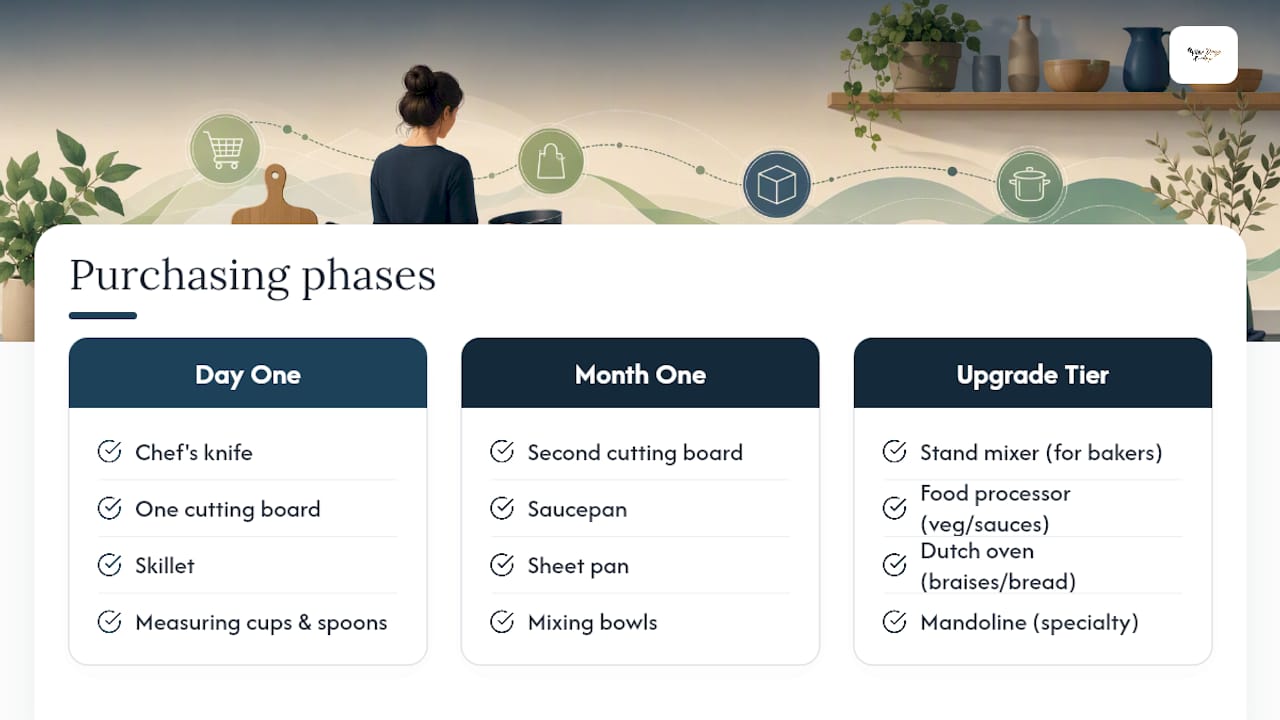
- How to Prioritize: Day-One, Month-One, and Upgrade Tiers
- Picking the Right Materials Without Overthinking It
- Keeping Your Tools Working Longer
- Gadgets to Skip and What to Buy Instead
- Why Wine Drop Cookery Built This List
- Your First Week With a New Kitchen Setup
- Shop the Essentials Wine Drop Cookery Actually Recommends
- Sources
- FAQ
What Are Kitchen Essentials, and Why This Short List Works
Kitchen essentials are the small set of tools that let you handle the vast majority of recipes without reaching for a specialty gadget. The concept isn’t about owning less for its own sake. It’s about recognizing that a handful of well-made basics outperforms a drawer full of single-purpose tools you’ll use twice.
Editorial testing backs this up. Serious Eats has found that a compact core set, chef’s knife, cutting board, skillet, saucepan, sheet pan, mixing bowls, measuring tools, kitchen scale, tongs, wooden spoon, and thermometer, reliably covers the bulk of home cooking. You don’t need 71 items to feel confident in your kitchen. You need the right dozen, chosen well, and used often.
The 10 Tools to Buy First (and What to Get)
This is your must-have kitchen tools list, ranked by how much they’ll actually change your cooking. Buy from the top down.
1. Chef’s Knife
An 8-inch chef’s knife does about 90% of the cutting work in any home kitchen, according to Preppy Kitchen’s testing, which makes it the single most important tool you’ll own. Buy one you can comfortably grip and keep sharp; a $40 knife you maintain weekly beats a $200 knife left dull in a drawer. Round it out eventually with a paring knife for small detail work and a serrated knife for bread and tomatoes, but the chef’s knife comes first, always. If you want to build real speed and confidence with it, our beginner’s guide to knife techniques walks through the grips and cuts that matter most.
2. Cutting Boards (Two, Not One)
Keep one wood board for produce and bread, and one plastic board reserved for raw meat and poultry. This isn’t fussiness, it’s food safety: wood is harder to fully sanitize once raw meat juices soak in, while plastic can go through a full wash cycle without holding onto bacteria. Look for at least 12 by 18 inches so you have room to actually work without vegetables sliding onto the counter.
3. Mixing Bowls
A nesting set of stainless steel bowls in three or four sizes handles everything from tossing salad to whisking pancake batter. Add one clear glass bowl to the mix for jobs where you need to see through the batter, like checking if egg whites have reached stiff peaks.
4. Measuring Cups and Spoons
Keep dry measuring cups (the kind you scoop and level) separate from a liquid measuring cup with a spout for pouring. Mixing the two up is a common beginner mistake that throws off baking ratios more than people realize.
5. Kitchen Scale
This is the one item beginners consistently skip and shouldn’t. Flour measured by volume can vary by roughly 20% between cooks, which is enough to turn a good cookie recipe into a dry, crumbly one. A digital scale costs $15 to $25 and solves the problem permanently. For anyone leaning into baking, pair it with the tools in our baking and pastry essentials collection.
6. Skillet
A 10 to 12-inch skillet is your workhorse pan. Cast iron holds heat well and lasts decades if you care for it properly; stainless steel is more forgiving for beginners and browns food beautifully once you learn to preheat it correctly. Either material earns its spot, but skip nonstick as your only skillet, since it degrades faster and can’t handle high heat searing.
7. Saucepan
A 3-quart saucepan handles rice, sauces, soups for two, and reheating leftovers. Go stainless steel or a stainless clad option so you get even heating without worrying about scratching a coating.
8. Sheet Pan
Buy one heavy-gauge half-sheet pan (18 by 13 inches). Cheap, thin sheet pans warp the first time they hit high oven heat, and a warped pan means uneven roasting from that point forward, according to Serious Eats testing. This is one item where spending a little more upfront saves you from replacing it in six months.
9. Dutch Oven (Optional but Versatile)
A 5 to 7-quart Dutch oven isn’t strictly day-one essential, but it’s the piece that unlocks braising, soups, bread baking, and one-pot dinners. If your budget allows for an 11th item after the core ten, this is where it goes.
10. The Small Utensils That Do Real Work
Round out your basic cooking supplies with a wooden spoon (won’t scratch pans, doesn’t conduct heat), a silicone spatula (flexible enough to scrape bowls clean), tongs (an extension of your hand for flipping and serving), a whisk, and a vegetable peeler. Add an instant-read thermometer to this group, since it’s the only reliable way to know when chicken has hit a safe 165°F internally, rather than guessing based on color.
Pro Tip: Buy your tongs before your spatula. New cooks underestimate how often tongs get used, flipping bacon, plating pasta, turning roasted vegetables, serving salad. They quietly become the most-reached-for tool in the drawer.
How to Prioritize: Day-One, Month-One, and Upgrade Tiers
You don’t need to buy everything at once, and multiple editorial sources recommend a tiered buying approach that reduces wasted spending while you figure out how you actually cook. Here’s how to phase it.
Day one: Chef’s knife, one cutting board, a skillet, measuring cups and spoons, and a wooden spoon. This gets you cooking dinner tonight.
Within the first month: Second cutting board, saucepan, sheet pan, mixing bowls, kitchen scale, tongs, and an instant-read thermometer. These fill in the gaps that day-one shopping left open, especially anything involving baking or roasting.
Upgrade tier, buy only once you know you’ll use it: A stand mixer if you bake regularly, a food processor if you cook a lot of vegetables or make your own sauces, a Dutch oven for braises and bread, and specialty items like a mandoline or immersion blender once a specific recipe habit justifies them.
Budget-wise, a functional starter kitchen can be assembled for roughly $200 to $300 if you prioritize the core list and choose solid workhorse brands over premium ones. A balanced budget of $400 to $600 gets you better steel and more durable nonstick coatings. An investment budget above $800 typically goes toward a quality knife set and cast iron or clad stainless cookware built to outlast you.
Picking the Right Materials Without Overthinking It
Material choice is where most beginners either overspend or buy the wrong tool entirely, so a little guidance here saves real money.
- Knife steel: High-carbon stainless steel holds an edge longer and resists rust better than plain carbon steel, and it’s the standard choice for a first chef’s knife.
- Pan material: Choose cast iron for searing and long-term durability, stainless steel for sauces and even browning, and save nonstick for eggs and delicate fish where sticking is the main concern.
- Cutting board material: Wood is gentler on knife edges and better for produce; plastic goes in the dishwasher and is safer for raw meat.
- When to spend more: Pay up for the chef’s knife and the skillet, since you’ll use both daily. Save money on items you’ll use occasionally, like a Dutch oven or specialty pan.
A wood cutting board paired with a dedicated meat board is a food safety habit worth adopting early, and this partner guide on kitchen sanitation and safety covers the sanitizing routine in more depth, especially useful if you’re cooking for family members with weaker immune systems.
The stainless bowl and glass bowl combination recommended by Preppy Kitchen is a good example of matching material to task rather than buying one set and hoping it covers everything.
Keeping Your Tools Working Longer
Good tools reward a little upkeep, and none of it takes long once it’s a habit.
- Hone your knife before every cooking session. A few passes on each side with a honing rod realigns the edge and keeps cuts clean, and reserving whetstone sharpening to once or twice a year is enough for most home cooks.
- Season and dry cast iron immediately after washing. Skip soap if you want to preserve the seasoning, and apply a thin layer of oil while the pan is still warm to prevent rust, a routine Serious Eats recommends for anyone new to cast iron.
- Wash cutting boards and thermometers thoroughly after each use, especially after contact with raw meat, and let boards air dry fully before storing them.
- Store knives in a block, on a magnetic strip, or with blade guards, never loose in a drawer where the edge dulls faster and fingers are at risk.
Pro Tip: Set a phone reminder for whetstone sharpening every four months. Honing alone won’t fix a truly dull edge, and a dull knife is more dangerous than a sharp one because it slips instead of cutting cleanly.
Gadgets to Skip and What to Buy Instead
Plenty of “essential kitchen gadgets” sold online solve a problem you don’t have. Chef and test-site roundups consistently flag unitaskers as clutter rather than necessity.
- Skip the garlic press. A chef’s knife and the flat side of a can smash a clove just as fast.
- Skip the avocado slicer. Same knife, thirty seconds, one less tool to wash.
- Skip the pancake batter dispenser and the strawberry huller. Both solve a problem your hands already solve.
- Buy a bench scraper instead. It handles dough, transfers chopped vegetables, and cleans your counter, three jobs from one flat piece of steel, per Food & Wine’s testing.
- Buy a microplane and an immersion blender. Both replace multiple single-purpose graters and blenders you’d otherwise need shelf space for.
Small kitchens benefit from a drawer divider and a magnetic knife strip; both free up counter space without adding another box to store.
Why Wine Drop Cookery Built This List
Alan put this guide together after seeing how many new cooks buy the wrong ten items instead of the right ten. Some kitchenware collections are curated around criteria like durability, multi-function value, and honest pricing that doesn’t inflate for a brand name alone. Some collections lean toward handmade knife sets and heavy-gauge cookware rather than trend gadgets. Quality tools don’t make you a better cook overnight, but they remove the friction that makes cooking feel like a chore, and that friction is often what stops beginners from cooking at all.
- Alan
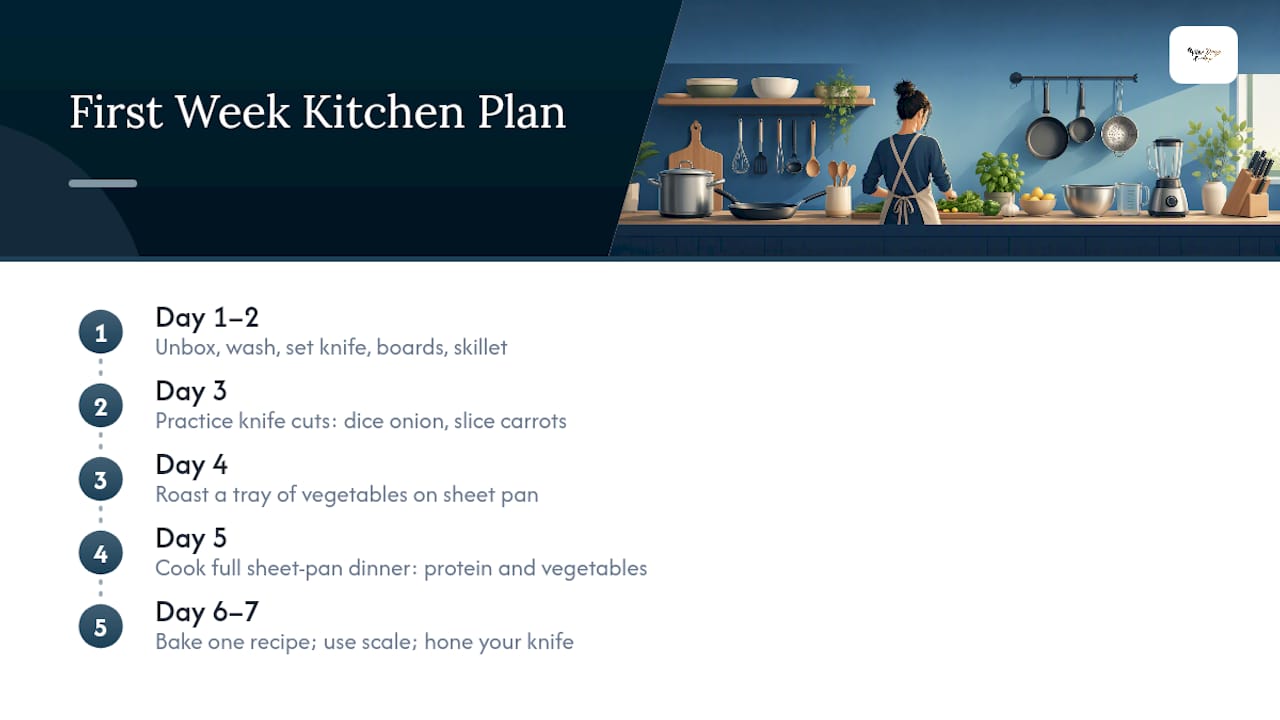
Your First Week With a New Kitchen Setup
Getting comfortable with new tools takes days, not months, if you use them with intention.
Day 1 to 2: Unbox everything, wash it, and set your knife, cutting boards, and skillet within easy reach. Day 3: Practice basic knife cuts, dicing an onion, slicing carrots into coins, until your grip feels natural rather than tense; our beginner cooking guide has a simple drill for this. Day 4: Roast a tray of vegetables on your sheet pan to get a feel for oven timing. Day 5: Cook a full sheet-pan dinner, protein and vegetables together, to see your tools work as a system. Day 6 to 7: Try one baking recipe using your kitchen scale, and get in the habit of honing your knife before you start.
Small repeated actions, honing before cooking, prepping ingredients before turning on the heat, build real kitchen confidence faster than any single expensive tool ever could.
Shop the Essentials Wine Drop Cookery Actually Recommends
You could piece this list together from five different stores, guessing at quality with each purchase. Some curated shops offer durable, multi-use kitchen essentials in one place, so the skillet, knife, and utensils you buy are built to outlast a single cooking season.

The kitchen essentials collection covers the core tools from this guide in materials chosen for longevity, not just looks. If you want a concrete example of what “durable and multi-use” looks like in practice, the Silicone Basting Brush and Spatula Set bundles a spatula, a whisk, and a basting brush into one purchase instead of three separate decisions. Start there, add a chef’s knife from the collection when you’re ready, and build the rest of your kitchen at your own pace.
Sources
- Essential kitchen tools & utensils - Preppy Kitchen
- The Best Kitchen Essentials of 2026, Tested & Reviewed - Serious Eats
- Essential kitchen tools: what you actually need - The Whole Fork
- The 16 Best Kitchen Tools, Tested & Reviewed - Food & Wine
FAQ
What Are Kitchen Essentials?
Kitchen essentials are the core tools, a chef’s knife, cutting boards, a skillet, a saucepan, a sheet pan, mixing bowls, measuring tools, a kitchen scale, tongs, a wooden spoon, and an instant-read thermometer, that together handle the vast majority of home cooking tasks.
What Are Some Essential Items for a Kitchen?
Beyond the core dozen, useful additions include a whisk, a vegetable peeler, a silicone spatula, and a Dutch oven once you start braising or baking bread regularly.
What Are the Kitchen Must-Haves for a Beginner?
Start with an 8-inch chef’s knife, one cutting board, a skillet, measuring cups and spoons, and a wooden spoon. These five items let you cook a full meal on day one, and you build out from there within your first month.
What Are 20 Common Items Found in a Kitchen?
A well-stocked kitchen typically includes a chef’s knife, paring knife, serrated knife, two cutting boards, a skillet, a saucepan, a Dutch oven, a sheet pan, mixing bowls, measuring cups, measuring spoons, a kitchen scale, tongs, a wooden spoon, a silicone spatula, a whisk, a vegetable peeler, an instant-read thermometer, a bench scraper, and a colander.
Do I Really Need a Kitchen Scale to Start Cooking?
You can cook without one, but if baking is part of your plans, a scale removes the roughly 20% measuring variance that comes from measuring flour by volume, making it one of the cheapest upgrades for consistent results.
0 comments