
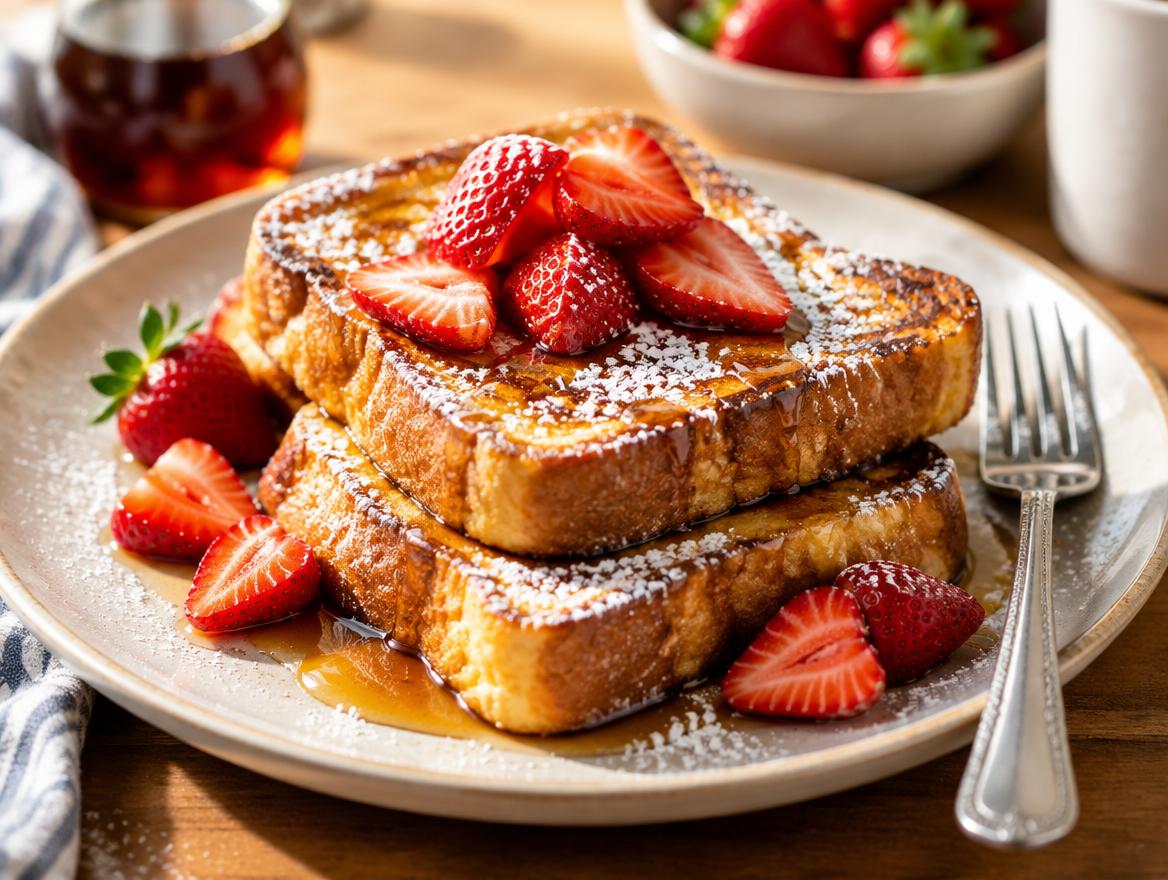
French toast is a custard problem, not a bread problem. Egg, milk, and a little sugar form a custard base that the bread soaks up; cook it right and the inside sets soft and creamy while the outside browns and crisps. Get the soak time or the ratio wrong and you either get a soggy center or bread that never absorbs anything at all.
Day-old or lightly stale bread is not a suggestion, it matters mechanically: fresh bread is too soft and falls apart in the custard, while bread that has dried out slightly has structure that holds together while it drinks in liquid.
Classic French Toast
Serves 4, eight slices. Prep 10 minutes, soak 2 minutes per side, cook 15 minutes.
Ingredients
- 8 slices day-old brioche, challah, or thick-cut white bread
- 4 large eggs
- 1 cup whole milk
- 1/4 cup heavy cream
- 3 tablespoons sugar
- 1 teaspoon vanilla extract
- 1/2 teaspoon ground cinnamon
- Pinch of salt
- Butter, for the pan
- Powdered sugar, maple syrup, and fresh berries, for serving
Method
- Whisk the eggs, milk, cream, sugar, vanilla, cinnamon, and salt together in a wide, shallow dish until fully combined.
- Heat a griddle or skillet over medium heat and add a pat of butter.
- Dip a bread slice into the custard and let it sit about 20 to 30 seconds per side, long enough to soak through without turning to mush. Let excess custard drip off before it hits the pan.
- Cook the slice 2 to 3 minutes per side, until deep golden brown and the center springs back when pressed.
- Check one slice by cutting in: the center should look custardy, not raw or wet, and the internal temperature should read at least 160F, the same safe minimum as any dish built on beaten eggs.
- Repeat with the remaining slices, adding more butter to the pan as needed.
- Dust with powdered sugar and serve hot with maple syrup and berries.
Nutrition (per serving, estimated)
Estimated for one of four servings, two slices each, not lab verified.
| Calories | Protein | Carbohydrate | Fat | Fiber | Sodium |
|---|---|---|---|---|---|
| 430 | 14 g | 45 g | 21 g | 1 g | 420 mg |
Tips and Variations
- No stale bread on hand: dry fresh slices in a 300F oven for about 8 minutes to mimic the texture without fully toasting them.
- Stuffed French toast: sandwich a thin layer of cream cheese and jam between two slices before dipping and cooking as one thicker piece.
- Keep a batch warm: hold finished slices on a rack in a 200F oven, not stacked, while you finish cooking the rest.
- Richer custard: swap the milk for half-and-half if you want a denser, more dessert-like texture.
Frequently Asked Questions
Why is my French toast soggy in the middle?
Either the bread soaked too long, or the pan was too hot so the outside browned before the center finished cooking. Keep the soak brief and the heat at a steady medium.
Can I use fresh bread instead of stale?
You can, but it falls apart faster in the custard. Dry it in a low oven first if it is fresh from the bakery.
What is a safe internal temperature for the custard?
Because the base is beaten eggs, cook until the center reaches at least 160F, the standard safe minimum for egg-based dishes according to USDA food safety guidance.
Can I prep the custard the night before?
Yes, whisk it and refrigerate in a covered container overnight. Give it a quick re-whisk before dipping, since the ingredients can separate slightly as they sit.
Tools for the Job
- Signature Skillet Collection for even browning
- Two-Tone XL Cutting Board for slicing bread and fruit
- Kitchen Essentials
More Breakfast Recipes
These publish together as a set. The full breakfast index lists all nine in one place.
Who Is Writing This
I am Chef Alan. I have spent 35 years in professional kitchens, I have formal culinary training in New Hampshire, and I have been honored as a 6-time 4-Diamond chef. More about me here. If a step did not make sense, get in touch and I will fix it.
Thank you for cooking this one with us. From all of us at Wine Drop Cookery.
Safe minimum internal temperature guidance for egg dishes from USDA FSIS, Shell Eggs from Farm to Table.