
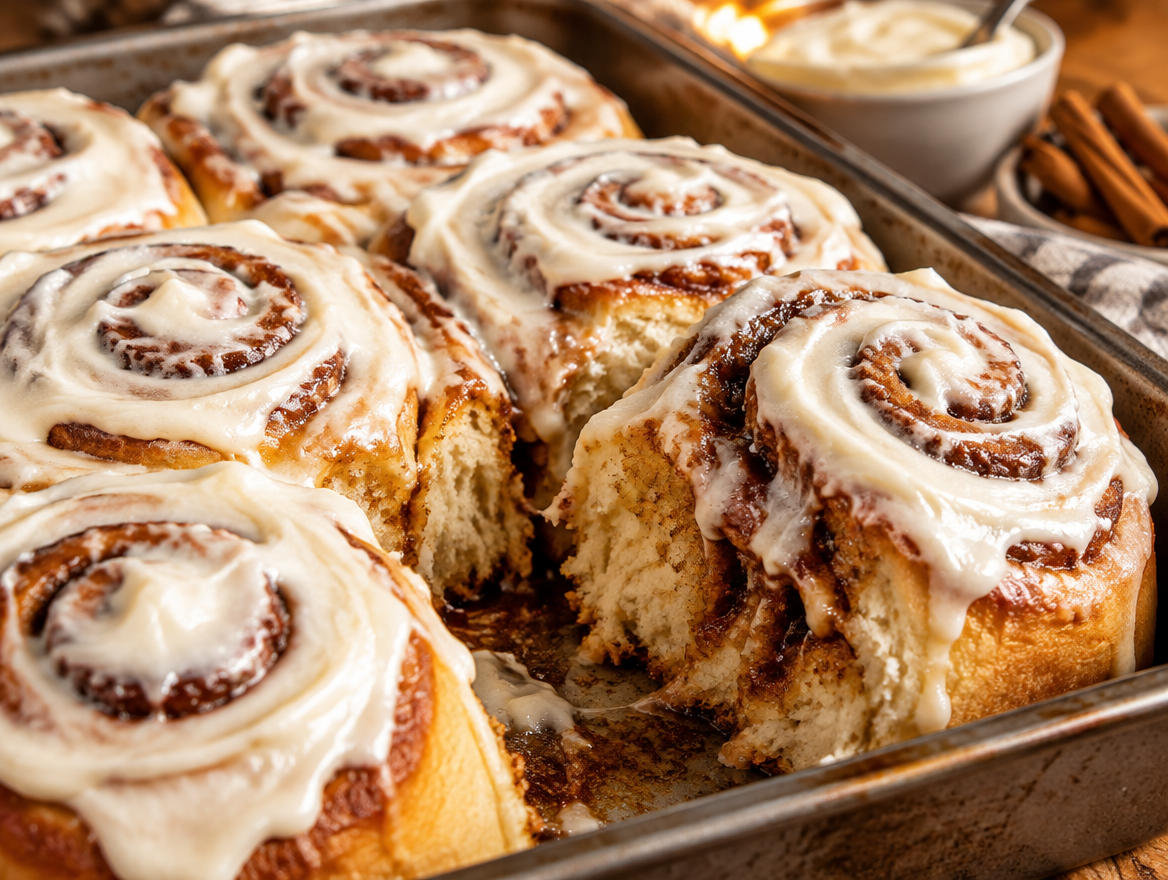
Cinnamon rolls are an enriched dough, meaning butter, egg, and sugar are worked into the flour alongside the yeast. That extra fat and sugar slow the yeast down and weigh the dough down, which is exactly why an enriched dough needs two full proofs, not one, to rise properly: once after kneading, and again after it is rolled, filled, and cut. Skip or shortcut the second proof and the rolls bake dense and tight instead of soft and pillowy.
Scalding the milk first, heating it until steaming and then cooling it to warm before adding the yeast, also helps: it deactivates an enzyme in raw milk that can otherwise weaken the dough's gluten structure over a long proof.
Cinnamon Rolls
Serves 4, eight rolls (two per serving). Prep 30 minutes, proof 2 hours total, bake 25 minutes.
Ingredients
For the dough:
- 3/4 cup whole milk, scalded and cooled to 110F
- 2 1/4 teaspoons (1 packet) active dry yeast
- 1/4 cup sugar
- 1 large egg, plus 1 yolk
- 1/3 cup unsalted butter, melted and cooled
- 3 1/4 cups all-purpose flour
- 3/4 teaspoon salt
For the filling:
- 1/2 cup unsalted butter, softened
- 3/4 cup packed brown sugar
- 2 tablespoons ground cinnamon
For the icing:
- 4 ounces cream cheese, softened
- 1/4 cup unsalted butter, softened
- 1 1/2 cups powdered sugar
- 1/2 teaspoon vanilla extract
Method
- Whisk the cooled scalded milk with the yeast and a pinch of the sugar. Let sit 5 to 10 minutes until foamy; if it does not foam, the yeast is dead and you need a fresh packet.
- Whisk in the remaining sugar, egg, egg yolk, and melted butter. Add the flour and salt and mix until a shaggy dough forms.
- Knead by hand or with a dough hook for 7 to 8 minutes until smooth and elastic. Place in a greased bowl, cover, and let rise in a warm spot until doubled, about 1 hour.
- Punch down the dough and roll it out on a floured surface into a rectangle roughly 16 by 12 inches.
- Spread the softened butter evenly over the surface, then mix the brown sugar and cinnamon and sprinkle it evenly over the butter, pressing gently so it adheres.
- Starting from a long edge, roll the dough tightly into a log. Pinch the seam to seal. Cut into 8 equal rolls with a sharp knife or a length of unflavored dental floss slid underneath.
- Arrange in a greased 9 by 13 baking dish, cover, and let proof a second time until puffy and touching, about 45 minutes to 1 hour. This second proof is what keeps them soft.
- Bake at 350F for 22 to 25 minutes until golden on top and cooked through in the center.
- Beat the cream cheese and butter for the icing until smooth, then beat in the powdered sugar and vanilla. Spread over the rolls while still warm.
Nutrition (per serving, estimated)
Estimated for one of four servings, two rolls with icing each, not lab verified.
| Calories | Protein | Carbohydrate | Fat | Fiber | Sodium |
|---|---|---|---|---|---|
| 720 | 10 g | 92 g | 36 g | 2 g | 380 mg |
Tips and Variations
- Overnight version: after shaping and cutting, refrigerate the unproofed rolls overnight; pull them out to come to room temperature and finish proofing about an hour before baking.
- Too dense: almost always a skipped or shortened second proof, or dead yeast that never got the dough moving in the first place.
- Even slices: unflavored dental floss slides through soft dough cleaner than a knife, which can compress the spiral and flatten one side.
- Not sweet enough icing: add powdered sugar a couple tablespoons at a time until it reaches the sweetness and thickness you want; it firms up slightly as it sits.
Frequently Asked Questions
Why do cinnamon rolls need two proofs?
The first proof develops the dough's structure and flavor. The second, after shaping, gives the individual rolls their own rise so they bake soft instead of dense; skipping it is the most common reason rolls come out tight.
How do I know my yeast is still active?
Dissolve it in the warm milk with a pinch of sugar and wait 5 to 10 minutes. It should look foamy and smell yeasty. If nothing happens, the yeast is dead, the milk was too hot, or too cold, and you should start over with a fresh packet.
Can I make these the night before?
Yes, shape and cut the rolls, cover tightly, and refrigerate overnight before their second proof. Let them sit out to warm and finish proofing before baking, about an hour.
Why did my filling leak out during baking?
The seam was not pinched tightly enough, or the roll was cut with too much pressure, which pushes filling out the sides. Roll snugly, pinch the seam well, and use a gentle sawing motion or floss to cut.
Tools for the Job
- Essential Stand & Food Mixers for kneading the dough and beating the icing
- Baking Dessert & Pastry Essentials
- Two-Tone XL Cutting Board for rolling out the dough
More Breakfast Recipes
These publish together as a set. The full breakfast index lists all nine in one place.
Who Is Writing This
I am Chef Alan. I have spent 35 years in professional kitchens, I have formal culinary training in New Hampshire, and I have been honored as a 6-time 4-Diamond chef. More about me here. If a step did not make sense, get in touch and I will fix it.
Thank you for cooking this one with us. From all of us at Wine Drop Cookery.
Yeast dough and enzyme background from Colorado State University Extension's guide to leavening agents.