

Truffles are the fruiting bodies of underground fungi prized for aroma so intense that a shaving can perfume an entire dish, while chocolate truffles are ganache-based confections that borrow only the name and the rounded shape. This guide covers how to buy and store fresh truffles, when to reach for truffle oil instead, the cooking rules that protect their aroma, and a ganache recipe that will not fail you.
TL;DR:
- Truffles are underground fungi with aromas driven by sulfur compounds, which animals detect more effectively than humans.
- Cultivation is unreliable and takes years, especially for white Alba truffles, making wild harvesting and seasonal scarcity major price factors.
- Proper storage involves wrapping in paper towels and refrigerating for up to five days to preserve aroma, but freezing or drying can extend shelf life at aroma cost.
- White truffles should be shaved raw onto dishes just before serving, while black truffles tolerate gentle heat and are suitable for infusions and sauces.
- Most truffle oils use synthetic aroma compounds, making them suitable for finishing simple dishes, but they cannot replace the full aroma of fresh truffles.
Table of Contents
- What Are Truffles, Exactly?
- Why Are Truffles So Expensive?
- The Truffle Species Every Home Cook Should Know
- How to Buy and Store Fresh Truffles
- How to Cook and Serve Truffles the Right Way
- Truffle Oil vs. Fresh Truffle: When to Use Which
- A Fail-Safe Chocolate Truffle Recipe
- More Truffle Recipes and Variations Worth Trying
- How Are Truffles Hunted in the Wild?
- Can Truffles Be Farmed Like Other Crops?
- Can You Freeze or Dry Truffles for Longer Storage?
- When Is Truffle Season?
- What Wine Drop Cookery Thinks Every Home Cook Gets Wrong About Truffles
- Tools That Make Truffle Prep Easier
- Sources
- FAQ
What Are Truffles, Exactly?
A truffle is the fruiting body of a subterranean ascomycete fungus, meaning it grows entirely underground and never breaks the soil surface the way a mushroom cap does. The fungus lives in an ectomycorrhizal partnership with tree roots, mostly oak, hazel, and beech, trading sugars from the tree for minerals it pulls from the soil. That underground life is exactly why truffles need something else to spread their spores, since wind and light rarely reach them.
That something else is smell. Because a buried fungus cannot rely on a breeze to scatter its spores, it produces an aroma strong enough to attract animals willing to dig for it, which is the entire evolutionary point of the scent that chefs pay a premium for.
The chemistry behind that aroma involves a cluster of volatile organic compounds, several of them sulfur-based:
- Dimethyl sulfide (DMS) and dimethyl disulfide (DMDS), which contribute the earthy, almost garlicky base note found across most truffle species
- Bis(methylthio)methane, one of the compounds most associated with the sharper, more pungent character of white truffles
- 1-octen-3-ol, sometimes called “mushroom alcohol,” which adds a woodsy undertone shared with other fungi
These compounds don’t appear in fixed ratios. Soil composition, rainfall timing, and the specific host tree all shift the balance, which is why truffles from one hillside can smell noticeably different from truffles of the same species dug a few miles away. Terroir is not a wine-only concept.
Because humans can’t smell a truffle buried a foot underground, hunters rely on animals with far more sensitive noses. Trained dogs do most of the work today, though the underlying detection principle, sensitivity to those same sulfur compounds, hasn’t changed in centuries.
Why Are Truffles So Expensive?
Truffles cost what they cost because they resist almost every shortcut that normally brings food prices down: they can’t be reliably farmed at scale, they fruit for only a few months a year, and grading adds another layer of price stratification on top of basic scarcity.
Start with cultivation. Black Périgord truffles (Tuber melanosporum) can be cultivated with inoculated tree seedlings, though yields remain unpredictable and orchards often take seven to ten years to produce a meaningful harvest. White Alba truffles (Tuber magnatum) are tougher still. Despite decades of attempts, cultivation has not produced reliable, scalable yields, so nearly every white truffle on the market was dug from the wild, not grown on a farm. That single fact explains most of the price gap between black and white varieties.
Weather then decides the rest. A dry autumn in Piedmont or a wet one in the Dordogne can shrink or expand the season’s total harvest by a wide margin, and since supply can’t be manufactured to meet demand, prices swing with the weather report.
Statistic Callout: Top-grade white truffles have historically traded at thousands of Swiss francs per kilogram during peak scarcity, with prices climbing further at charity auctions for record-setting specimens. Mid-grade, imperfect truffles from the same harvest often sell for a fraction of that price.
Grading matters as much as species. A truffle with a round shape, uniform color, and no insect damage commands far more than a broken or blemished one with identical aroma. If you’re buying for a dinner party rather than a photo, ask your dealer about “second grade” truffles. You’ll often get the same scent for noticeably less money.
The Truffle Species Every Home Cook Should Know
Not all truffles behave the same way in the kitchen, and knowing which species you’re holding changes how you should cook with it.
Tuber magnatum (white Alba truffle) is the most aromatic and most expensive truffle sold commercially. Its season runs roughly October through December, and its aroma, heavy on garlic and gassy top notes, degrades fast under heat. The longstanding rule is simple: never cook it. Shave it raw over a finished, warm dish and let residual heat do the work.
Tuber melanosporum (Périgord black truffle) is the workhorse of professional kitchens, harvested from roughly December through March. It has a firmer texture and a deeper, more chocolatey earthiness than its white cousin, and it tolerates gentle warmth far better, which is why it shows up infused into butter or simmered briefly in cream sauces.
Oregon truffle species (Tuber gibbosum, T. oregonense, and the unrelated Leucangium carthusianum, often called the Oregon black truffle) grow wild in the Pacific Northwest and are increasingly available through domestic foragers and seasonal festivals. They’re milder than their European counterparts but genuinely good, and buying domestic cuts shipping time dramatically, which matters enormously for a product that starts losing aroma the moment it’s dug.
A few other species round out the market:
- Summer/Burgundy truffle (Tuber aestivum), milder and more affordable, harvested in warmer months
- Desert truffles (Terfezia and Tirmania species), popular across North Africa and the Middle East, with a milder, more potato-like flavor than European varieties
- Chinese truffle (Tuber indicum), visually similar to Périgord black but noticeably less aromatic, often sold at a steep discount and sometimes mislabeled as the real thing
How to Buy and Store Fresh Truffles
Buying a fresh truffle without getting scammed comes down to knowing exactly what to check before you hand over payment.
- Buy from specialist dealers or certified importers, not general grocery suppliers. Seasonal farmers markets during peak harvest months (October through March, depending on species) are also reliable if the vendor can show provenance.
- Ask for the harvest or arrival date. A truffle more than a week off the ground has already lost significant aroma, even if it still looks presentable.
- Check for a certificate or invoice noting origin and species. Reputable dealers provide this without being asked twice.
- Inspect on delivery. A fresh truffle should feel firm, not spongy, and should smell intensely earthy the moment you open the packaging. A faint or musty smell is a red flag.
- Watch for common frauds, including truffles injected with synthetic aroma to mask age, or lower-value species mislabeled as Périgord or Alba.
Once you have a truffle in hand, store it in the refrigerator around 35 to 39°F, wrapped loosely in paper towels or cheesecloth inside a sealed container. Change the paper daily since it absorbs both moisture and aroma. Use it within three to five days; aroma loss accelerates fast after that window, so plan your menu before you buy, not after.
Pro Tip: Save the paper towels you use for storage. They absorb enough truffle aroma to flavor a batch of scrambled eggs or a bowl of popcorn on their own.
How to Cook and Serve Truffles the Right Way
The single biggest mistake home cooks make with truffles is cooking them like an ingredient instead of treating them like a finishing touch.
The professional rule is to bring the truffle to the plate, not the plate to the truffle: shave it raw over a dish that’s already hot and ready to serve. For white truffle especially, the window between slicing and eating should be under an hour for full aroma impact, since the volatile compounds that make it special start dissipating the moment the flesh is exposed to air.
For tools, a dedicated truffle shaver or a fine mandoline gives you thin, even slices that release aroma efficiently; a microplane works in a pinch but produces a finer shred that can clump. Portion-wise, plan on 5 to 10 grams of white truffle per serving for a noticeable effect, or slightly more for the milder black variety.
A short list of dishes that showcase truffle without fighting it:
- Fried or soft-scrambled eggs, where the fat carries the aroma beautifully
- Buttered pasta, especially something simple like homemade Alfredo, where the sauce has nothing else competing for attention
- Risotto, finished off the heat right before plating
- Roasted or mashed potatoes, whose starch and fat both hold aroma well
For presentation, shave generously but evenly across the surface of the dish rather than piling slices in one spot. Guests should smell the truffle before the plate even reaches the table.
Pro Tip: If a dish tastes flat after adding truffle, the problem is usually fat, not truffle. Aroma compounds are fat-soluble, so a pat of butter or a drizzle of good olive oil right before shaving amplifies the effect more than adding more truffle does.
Truffle Oil vs. Fresh Truffle: When to Use Which
Truffle oil and fresh truffle are not interchangeable, and treating them as such is where most home cooks go wrong.
Most commercial truffle oils rely on a synthetic compound called 2,4-dithiapentane rather than actual truffle infusion. That compound mimics one specific aromatic note found in real truffles, usually the black variety’s profile, but it can’t replicate the fuller, layered scent of the fungus itself. That’s not a scandal, just a fact worth knowing before you pay a premium expecting fresh-truffle intensity from a bottle.
Used correctly, though, truffle oil earns its place in a home kitchen. Think of it as aromatic precision: a finishing gesture for simple, fat-rich dishes like popcorn, fries, or a basic risotto, rather than the star of an expensive plate. Fresh truffle is for the dish that deserves the real complexity; oil is for the Tuesday night dish that just needs a lift.
A few practical rules for using oil well:
- Apply 3 to 5 drops per portion. Professional guidance is specific here, and more is not better since the synthetic note can turn chemical-tasting past a certain point.
- Never expose it to sustained heat. Add it off the heat or at the very end of cooking, the same rule that governs fresh truffle.
- Match oil color to dish. White truffle oil suits lighter dishes like seafood or mashed potatoes; black truffle oil pairs better with heartier fare like steak or mushroom dishes.
Statistic Callout: Synthetic truffle oils have been on the market since the 1980s, meaning most “truffle-flavored” products you’ll find at a grocery store predate any personal memory of fresh truffle by decades.
A Fail-Safe Chocolate Truffle Recipe
Chocolate truffles share nothing with fungal truffles except a round shape and a name borrowed from their resemblance to the real thing rolled in dirt. What they do share with good cooking generally is that ratio and technique matter more than fancy ingredients.
A classic chocolate truffle is a ganache, meaning chocolate melted into cream, chilled, and rolled. Start with a roughly 1:1 ratio by weight of good-quality chopped chocolate to heavy cream for a firm, easy-to-roll truffle; shift closer to 2:1 chocolate to cream if you want a denser, more intensely flavored center. Use real chocolate with at least 60% cacao rather than chocolate chips, which contain stabilizers that can affect texture.
Step-by-step method:
- Chop chocolate finely and place it in a heatproof bowl.
- Heat cream in a saucepan just until it starts to steam, not boil.
- Pour the hot cream over the chocolate and let it sit undisturbed for two full minutes.
- Whisk gently from the center outward until fully smooth and glossy. This is the emulsification step, and rushing it is the most common cause of failure.
- Cover and refrigerate for at least two hours, or until firm enough to scoop.
- Scoop small portions and roll quickly between your palms; cold hands help here more than you’d think.
- Coat in cocoa powder, melted chocolate, chopped nuts, or sprinkles, then chill again until set.
Troubleshooting:
- Grainy or seized ganache usually means the chocolate got too hot, or water contaminated the mixture. Rewarm gently over a double boiler and whisk in a small splash of warm cream to bring it back.
- Too soft to roll means more chilling time is needed, or your cream ratio ran too high; add a bit more melted chocolate next time.
- Too hard or waxy usually points to overheated cream or too little fat; a small pat of butter whisked in at the end can soften texture.
- Storage: finished truffles keep in an airtight container in the refrigerator for up to two weeks, or in the freezer for up to three months. Bring to room temperature for 15 minutes before serving for the best texture.
More Truffle Recipes and Variations Worth Trying
Once you’ve got the base techniques down, both savory and sweet truffle dishes open up fast.
On the savory side, truffle butter (softened butter mixed with finely minced truffle or a few drops of oil) is the easiest entry point and works on everything from steak to toast. Truffle risotto finished with a shaving right before serving remains the classic showcase dish. Truffle eggs, whether scrambled or a simple omelet, let the fat carry the aroma with almost no competition. Truffle fries, tossed in truffle oil and salt right out of the fryer, are the crowd-pleaser that converts skeptics.
On the sweet side, chocolate truffles take well to variation. Salted-caramel ganache truffles swap a portion of the cream for a thick caramel sauce and finish with a pinch of flaky salt on top. Espresso truffles add a tablespoon of finely ground espresso or strong coffee to the warm cream before pouring it over the chocolate. Liqueur-infused truffles, made with a splash of Grand Marnier, amaretto, or bourbon whisked into the finished ganache, make excellent holiday gifts.
For serving, arrange chocolate truffles in small paper cups inside a lined box, and keep a card noting the flavor since guests always ask. For gifting, a simple kraft box tied with twine looks far more intentional than it is to make.
For those who want to pair a truffle course with the right glass, pairing guidance for white wine and food is a useful reference when planning a full menu around fresh truffle dishes.
How Are Truffles Hunted in the Wild?
Truffle hunting today relies almost entirely on trained dogs, a shift from the historical use of pigs that dates back centuries in parts of Europe.
Pigs have an extraordinarily sensitive nose for the same aromatic compounds that make truffles valuable, which is exactly the problem: pigs tend to eat what they find before the hunter can stop them. Dogs, trained from puppyhood to associate the scent with a reward rather than a meal, solve that problem while retaining nearly the same detection ability. Breeds like the Lagotto Romagnolo were developed specifically for this work and remain the standard in Italy today.
The hunt itself is unglamorous but precise. A trained dog works a patch of forest floor, often near the base of host trees like oak or hazel, and signals a find by scratching or freezing in place. The hunter then digs carefully by hand or with a small tool, taking care not to damage the truffle or disturb the mycelium network that will produce next season’s crop. Rushing this step is a common way inexperienced hunters ruin a find or damage future yields at the same site.
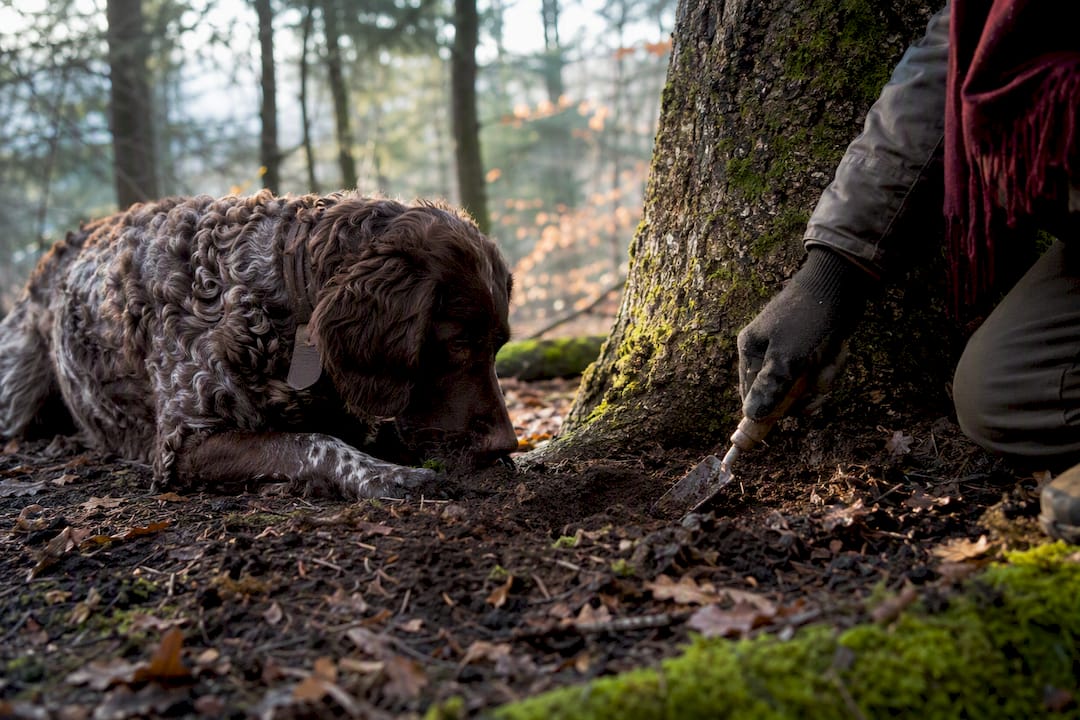
Timing and secrecy matter as much as the dog’s nose. Experienced hunters often work at dawn or in the early evening, both because scent travels better in cooler, damper air and because good truffle grounds are closely guarded secrets passed down within families. Location scouting, more than the dog itself, is often the real skill being handed down.
Can Truffles Be Farmed Like Other Crops?
Truffle cultivation exists, but it looks nothing like planting a row of tomatoes and waiting for a harvest.
The process starts with inoculating tree seedlings, usually oak, hazel, or beech, with truffle spores in a controlled nursery setting. Those seedlings are then planted in soil matched as closely as possible to conditions truffles favor: alkaline pH, good drainage, and a specific climate range. From there, growers wait. Black Périgord truffle orchards typically take seven to ten years before producing a meaningful harvest, and even then, yields vary year to year based on rainfall and soil conditions that growers can influence but not fully control.
White Alba truffle cultivation has proven far harder. Despite serious commercial interest and decades of trials, no cultivation method has reliably produced the scalable yields seen with black truffle orchards, which is the core reason white truffles remain overwhelmingly wild-harvested and priced accordingly.
Beyond Europe, cultivation programs in places like Australia, New Zealand, and parts of the United States have had real success with black Périgord truffle orchards, in some cases producing high-quality truffles in climates with no wild truffle tradition at all. That expansion has slowly stabilized black truffle supply compared to a few decades ago, even as white truffle scarcity remains largely unchanged.
Can You Freeze or Dry Truffles for Longer Storage?
Fresh truffles have a short shelf life, but freezing and drying both extend usability well beyond the few days you get from refrigeration alone, at some cost to peak aroma.
Freezing works best for cooking applications rather than raw shaving. Wrap the truffle tightly in plastic wrap, then foil, and freeze whole; grate or slice it directly from frozen into sauces, butter, or risotto. Aroma intensity drops somewhat compared to fresh, but the flavor holds up far better than most home cooks expect, especially for black truffle varieties.
Drying concentrates flavor into a different, more intense form rather than preserving the fresh profile. A food dehydrator or a low oven works; once fully dried, truffles can be ground into a powder for seasoning blends, infused into oils, or rehydrated in warm cream for sauces. Dried truffle keeps for months in an airtight container away from light.
Truffle-infused butter or oil is a third preservation route worth considering if you have more truffle than you can use fresh. Grating truffle into softened butter and freezing it in small portions locks in aroma for later use in a way that’s arguably more practical than either freezing or drying whole.
Whichever method you choose, label everything with the date. Truffle aroma fades gradually even in frozen or dried form, and a truffle butter from eighteen months ago will taste noticeably flatter than one made last month.
When Is Truffle Season?
Truffle availability follows a tight calendar that shifts by species and hemisphere, and knowing it prevents the disappointment of shopping for the wrong truffle at the wrong time of year.
White Alba truffle (Tuber magnatum) season runs from roughly October through December in Italy, with the earliest specimens of the year commanding the highest prices before supply catches up with demand. Black Périgord truffle (Tuber melanosporum) season runs longer, from December through March, giving cooks a wider window to work with the more heat-tolerant variety. Summer or Burgundy truffle (Tuber aestivum) fills the gap between the two, harvested from May through August and offering a milder, more budget-friendly option during warmer months.
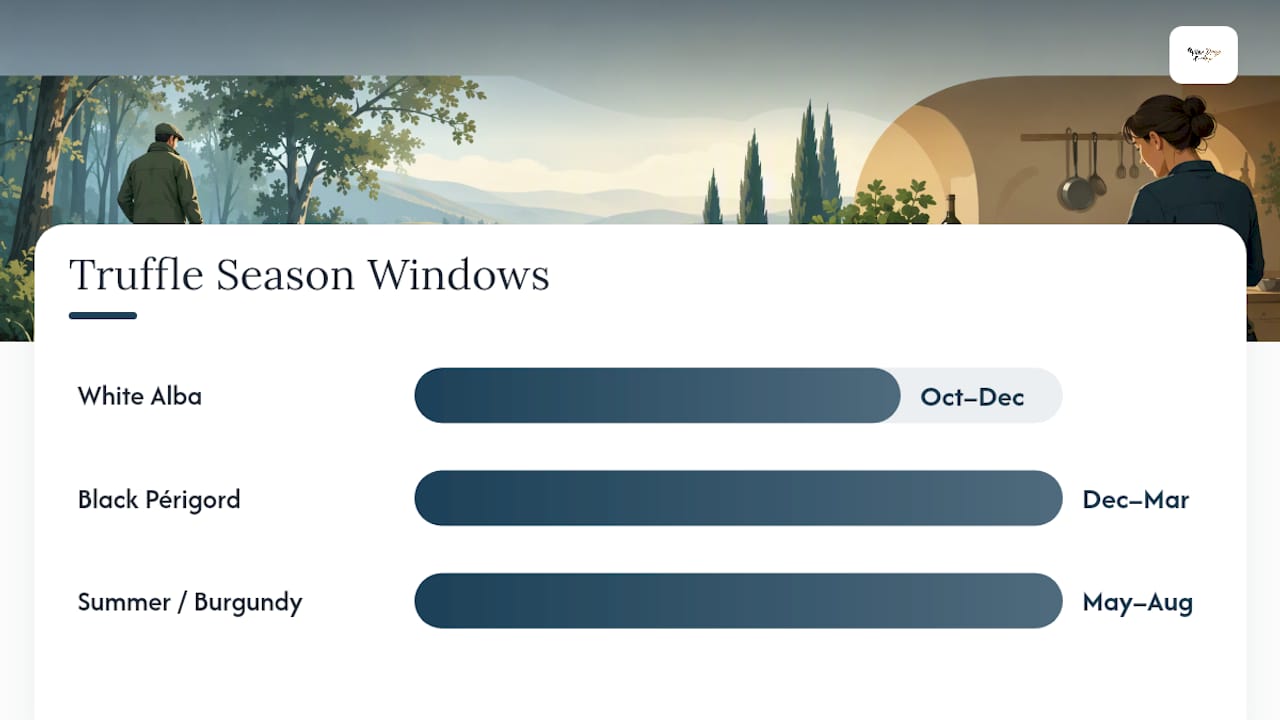
Oregon truffle species generally follow a similar timeline to their European counterparts, with peak harvest running from late fall through winter depending on the specific species and regional weather that season.
Buying at the very start or very end of a season carries risk. Early-season truffles sometimes lack full aroma development, while late-season specimens have had more time for pests or moisture damage.
What Wine Drop Cookery Thinks Every Home Cook Gets Wrong About Truffles
Most guides treat truffle prep as a luxury problem, something only worth solving once you’ve already spent a small fortune on the ingredient itself. That framing backwards. The tool matters just as much at $40 a truffle as it does at $400, because a dull blade crushes the cell walls that release aroma instead of slicing them cleanly, and a heavy hand with heat ruins the investment either way.
A sharp, thin-bladed chef’s knife does more for truffle prep than any specialty gadget, since clean, thin slices matter more than the shape of the tool making them. A digital thermometer earns its place too, not for the truffle itself but for the ganache base of chocolate truffles, where a few degrees of overheated cream is the difference between silky and grainy. Respect the ingredient’s rarity by using tools precise enough not to waste it.
Alan
Tools That Make Truffle Prep Easier
Good truffle technique depends on control, and control starts with the tools in your hand. A knife that slides cleanly through a delicate truffle without crushing it protects the exact aroma compounds you’re paying for, which is why a quality blade matters more here than almost anywhere else in the kitchen.
Wine Drop Cookery’s Mora Frosts 7-Inch Chef’s Knife gives you a thin 1.9 mm blade, precise enough to shave both fresh truffles and firmer black varieties without tearing the flesh. For the ganache side of things, chocolate truffles depend on getting cream temperature right, and the Digital Meat Thermometer takes the guesswork out of that step so you never scorch a batch. If you’re setting up a full truffle station for a dinner party, the Silicone Basting Brush and Spatula Set, with its spatula and whisk, handles the stirring and scraping on both the savory and sweet sides of this guide.
Browse the full kitchen essentials collection to find the right combination for your next truffle dish, whether that’s a simple weeknight risotto or a holiday batch of chocolate truffles.
Sources
- Tour of truffles: Aromas, Aphrodisiacs, Adaptogens, and More: PMC
- White Alba Truffle: The Truffle Encyclopedia
- How to Use Truffle Oil: Milan Truffle
- Basic truffles recipe: Allrecipes
FAQ
Is a Truffle a Mushroom or a Fungus?
A truffle is a fungus, specifically the underground fruiting body of an ascomycete fungus, but it is not a mushroom in the traditional sense since it never grows above ground or forms a visible cap and stem.
Why Are Truffles So Expensive?
Truffles are expensive because white varieties resist reliable cultivation and must be wild-harvested, seasons are short, and weather-driven yield swings mean supply can’t be scaled to meet demand the way most farmed crops can.
How Much Does 1 Pound of Truffles Cost?
Prices vary enormously by species, grade, and season; top-grade white Alba truffles have historically sold for thousands of dollars per pound during peak scarcity, while black Périgord and Oregon varieties typically run far lower.
Is It Healthy to Eat Truffles?
Truffles are low in calories and fat, contain some fiber and antioxidants, and are generally considered safe to eat when sourced from a reputable dealer, though they’re eaten in such small quantities that their nutritional impact is minor compared to their culinary role.
Can I Substitute Truffle Oil for Fresh Truffle in a Recipe?
You can, but expect a different result: most commercial truffle oils use a synthetic aroma compound that mimics one note of real truffle rather than replicating its full complexity, so it works better as an affordable finishing touch than a true substitute.
0 comments