

For most kitchen knives, sharpen within the commonly recommended range of degrees per side. Japanese slicers perform best at relatively acute angles, EDC and outdoor knives require angles oriented toward durability, and cleavers need more obtuse angles for strength. The exact number matters less than picking an angle your steel can hold and then repeating it every single stroke. When in doubt, match the factory edge instead of guessing.
TL;DR:
- Using the correct sharpening angle for your knife type is crucial, with Japanese slicers at 10-15 degrees per side and cleavers at 25-30 degrees; consistent angle holding is more important than exact numbers.
- Sharpens should match the factory angle or existing bevel, and microbevels can extend the edge’s life without enlarging the primary angle.
- Hardness range between HRC 58 and 62 allows for lower angles like 15 degrees per side on high-quality knives, but softer steels below HRC 56 require wider angles for durability.
- Maintaining a steady angle with guided systems, coin stacks, or marker tests accelerates learning and results better than freehand sharpening.
- Inconsistent angles cause chipping, rolling, or uneven dull spots, and professional reprofile may be necessary if the geometry is severely mismatched or damaged.
Table of Contents
- What’s the Difference Between Per-Side and Included Angle?
- What Angle Should You Use for Your Type of Knife?
- How Do You Find and Hold a Consistent Angle?
- How Does Steel Hardness Change Your Ideal Angle?
- When Should You Add a Microbevel or Reprofile?
- Why Is Your Knife Chipping or Rolling Instead of Cutting Clean?
- What Actually Matters Once You’ve Read the Charts
- Get Consistent Edges Without Guessing at the Angle
- Sources
- FAQ
What’s the Difference Between Per-Side and Included Angle?
Every angle you see quoted for knife sharpening angles is measured one of two ways, and mixing them up leads to a lot of confused shopping and worse edges. Per-side angle is the tilt of one bevel face against the stone. Included angle is both sides added together, the total wedge of steel at the apex.
A knife sharpened at 15 degrees per side has a 30 degree included angle. One sharpened at 20 degrees per side sits at 40 degrees included. That gap explains why a Japanese single-bevel slicer feels like it’s barely touching food while a robust German chef’s knife plows through a butternut squash without flinching. Lower included angles cut with less resistance but chip more easily, while wider angles sacrifice some slicing feel for an edge that survives contact with bone, cardboard, or a hurried prep cook.
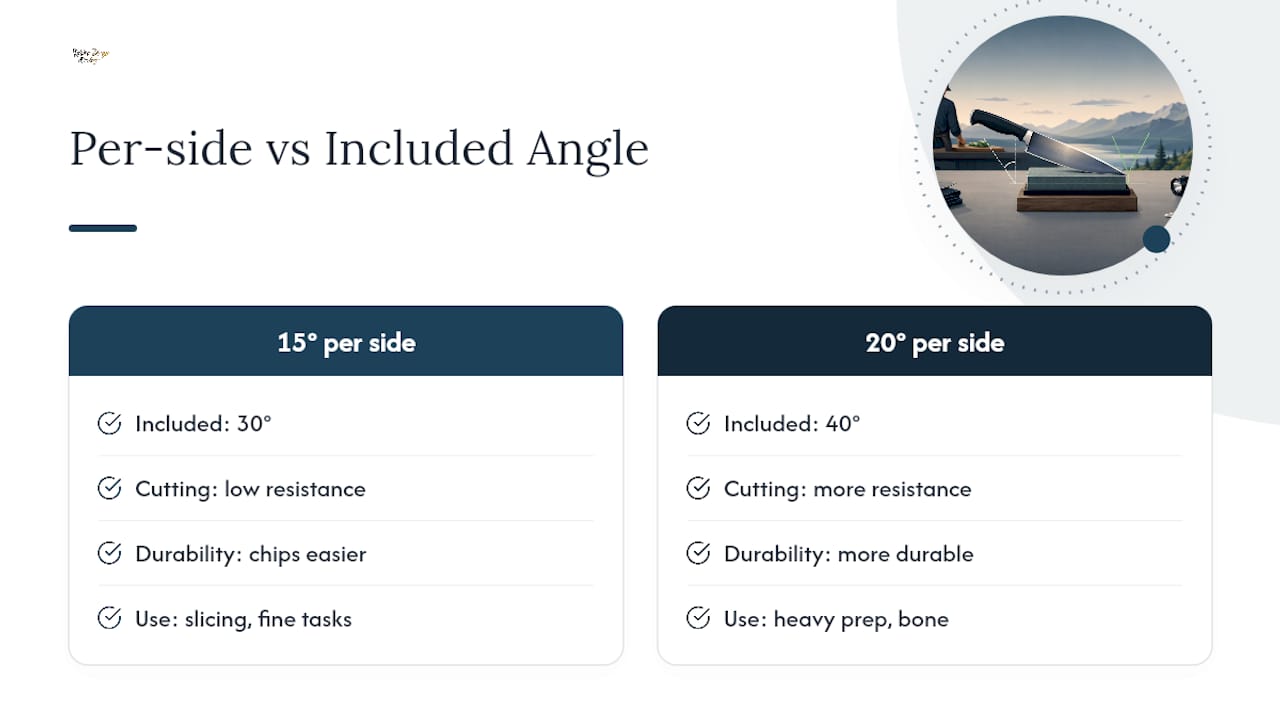
Here’s the part that trips up most home sharpeners: hitting exactly 17 degrees does not matter nearly as much as holding whatever angle you choose steady from heel to tip. A wobbly edge, even one aimed at a technically ideal number, sharpens unevenly and dulls faster than a slightly imperfect angle held with a rock-solid hand.
What Angle Should You Use for Your Type of Knife?
Different blades earn their keep at different angles, and the right starting point depends on what the knife actually does all day. Authorities on sharpening geometry generally agree on these per-side ranges:
| Knife type | Per-side angle | Why |
|---|---|---|
| Japanese single-bevel (yanagiba, deba) | 10 to 15 degrees | Built for clean push cuts through fish and produce; thin geometry, hard steel |
| Japanese double-bevel (santoku, gyuto) | 12 to 15 degrees | Balances slicing precision with everyday kitchen durability |
| Western chef’s knife | 15 to 20 degrees | Handles rocking cuts, bone contact, and cutting board abuse |
| German or robust kitchen knives | 18 to 22 degrees | Softer steel, thicker stock, prioritizes edge survival over shaving sharpness |
| EDC and pocket knives | 20 to 25 degrees | Mixed-use cutting on rope, boxes, and food demands a tougher edge |
| Hunting and outdoor knives | 20 to 25 degrees | Field use on cartilage, hide, and wood needs an edge that resists rolling |
| Cleavers and choppers | 25 to 30 degrees | Heavy impact cutting through bone requires maximum apex strength |
If you’re shopping for a chef’s knife or a santoku, lean toward the lower end of its range when the steel is hard and thin behind the edge, and toward the higher end when the blade is thicker stock meant for rough treatment.
How Do You Find and Hold a Consistent Angle?
Before you touch a stone, figure out what angle the factory already ground. The marker-bevel test is the fastest way: color the entire edge with a permanent marker, make one or two light passes on your stone, then check where the ink wore off. Ink gone at the very apex only means you’re too shallow. Ink gone across the whole bevel means you’ve matched the existing angle.
Once you know the target, holding it freehand takes practice. A few approaches work well for different skill levels:
- Spine-height method: estimate the gap between the spine and the stone using finger widths or a small ruler.
- Coin-stack trick: stack coins under the spine to approximate a known angle, useful for beginners training their hand.
- Visual half-angle check: picture the angle between the blade and the stone, then halve it in your head to sanity-check the per-side number.
- Guided aids: clip-on angle guides or a full jig remove the guesswork entirely and are worth the investment if freehand consistency isn’t clicking yet.
Guided systems and coin-stack approximations both work because they turn an abstract number into something your hand can feel and repeat.
Pro Tip: Run the marker test again after every few strokes during your first few sharpening sessions. Watching the ink disappear teaches your muscles the angle faster than any written instruction ever will.
How Does Steel Hardness Change Your Ideal Angle?
Rockwell hardness, abbreviated HRC, tells you how much abuse an edge can take before it either rolls over or chips out. Most working kitchen knives sit between HRC 58 and 62, and that range determines how acute an angle you can safely run.
Below roughly HRC 56, steel is soft enough that a thin edge folds under normal cutting pressure, so stick to wider angles in the 18 to 22 degree range. Between HRC 56 and 58, the steel holds up reasonably well at moderate angles. From HRC 58 to 62, the sweet spot for most premium kitchen knives, you can comfortably run 15 degrees or lower without the edge deforming. Push past HRC 62, common in powder steels and high-carbide blends, and the blade can hold extremely low angles, but it starts trading durability for chip resistance. Different steel families sharpen and hold edges very differently, which is part of why a VG10 blade and an AUS10 blade at similar hardness can still feel different off the stone.
Hardness alone doesn’t tell the whole story. Thickness behind the edge has to support whatever angle you’re aiming for. A thin 12 degree edge ground onto a thick, wedge-shaped blade won’t perform like a proper Japanese slicer. It’ll bind in the cut no matter how sharp the apex is. Check the grind before you commit to reprofiling toward a lower number.
When Should You Add a Microbevel or Reprofile?
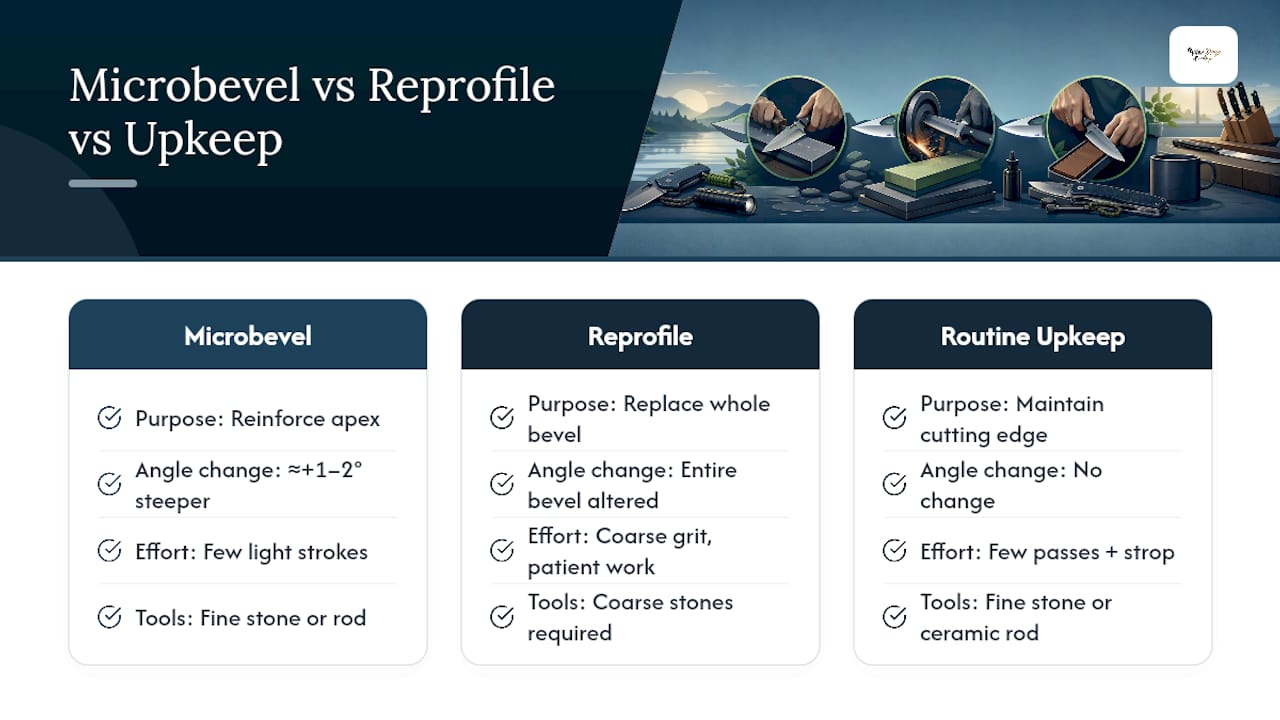
A microbevel is a small secondary edge, usually just 1 to 2 degrees steeper than your primary bevel, added with a handful of light strokes on a fine stone. It reinforces the apex without dulling the overall geometry. This tiny adjustment meaningfully extends edge life while barely affecting how the knife cuts.
Reprofiling, changing the entire bevel angle, is a bigger job that calls for coarse grit and real patience. Save it for knives with damaged edges or a factory angle that’s flatly wrong for how you use the blade. If you just need more durability day to day, a microbevel gets you there with far less work than a full reprofile.
For upkeep, a few passes on a fine stone or ceramic rod every week or two, followed by a strop, keeps most kitchen knives working without ever touching coarse grit again.
Why Is Your Knife Chipping or Rolling Instead of Cutting Clean?
Three symptoms cover almost every sharpening complaint, and each points to a specific fix:
- Chipping along the edge usually means the angle is too acute for the steel, or the steel itself is too brittle. Add a microbevel to reinforce the apex.
- The edge rolls over rather than cutting signals an angle that’s too shallow for a soft steel. Increase your per-side angle slightly and resharpen.
- Uneven wear or dull spots almost always trace back to an inconsistent hand angle. Run the marker test again and consider a guided jig.
If none of these fixes hold, or the geometry is seriously mismatched from years of bad sharpening, a professional reprofile resets the blade properly.
What Actually Matters Once You’ve Read the Charts
Pick the keenest angle you can hold reliably for the cutting you actually do, not the one that looks most impressive on paper. Matching factory specs or using a guided sharpener gets you consistent results faster than freehanding from day one. Run the marker test, add a microbevel where it makes sense, and let repetition do the rest.
— Alan
Get Consistent Edges Without Guessing at the Angle
Wine Drop Cookery makes hitting the right angle a non-issue instead of a skill you have to build over years. Our Knife Sharpener Ceramic Tungsten kitchen sharpening system locks in a fixed angle so every pass lands exactly where the last one did, which matters far more than chasing a perfect number freehand.

If your knives need real reprofiling work, not just touch-ups, the 4-Stage Kitchen Knife Sharpener with stone, tungsten, and diamond stages handles everything from a dull edge to a full angle correction in one tool. Both are built for beginners who want repeatable results without buying separate whetstone grits or learning to hold a steady freehand angle first. Browse our full kitchen essentials collection to pair a sharpener with a knife set that’s worth keeping sharp, and check out our Damascus steel chef’s knife set if you’re ready to upgrade the blades themselves.
Sources
- NCBI article on blade materials and performance
- Knife Sharpening Angle Guide: The Complete Chart for Every Knife Type
- A practical guide to sharpening angles
- Knife Sharpening Angles Explained — Which Angle for Which Knife
- Common knife blade steels
FAQ
How Do I Know if My Knife Is 15 or 20 Degrees?
Run the marker-bevel test: color the edge, make a couple of light passes on your stone, and see how much ink wears off across the bevel. If ink disappears evenly at a shallow angle, you’re likely near 15 degrees; if it takes a steeper tilt to clear the ink, you’re closer to 20.
Is 20 or 25 Degrees Sharper?
A 20 degree per-side edge is sharper and slices more easily than a 25 degree edge, but the 25 degree edge holds up better against bone, cartilage, and rough use. Choose based on what the knife actually cuts, not which number sounds more precise.
What Is a 70/30 Knife Bevel?
A 70/30 bevel is an asymmetric grind where one side of the edge carries 70% of the bevel angle and the other side carries 30%, common on some Japanese knives designed for right or left-handed use. It changes how the blade tracks through a cut rather than changing the core sharpening angle math.
Do You Push or Pull When Sharpening a Knife?
Either direction works as long as you maintain a consistent angle and light pressure; many sharpeners push the edge away from the body to feel the bevel meet the stone, then pull back on lighter finishing strokes. Consistency of angle and stroke matters far more than which direction you choose.
What’s the Best Whetstone Grit to Start With?
Start reprofiling or repairing damage with a coarse grit, then move to finer grits for a refined edge, and finish with a finest grit if you want a polished, food-slicing finish. The 1000 vs 6000 grit gap is the difference between removing steel and refining the apex you’ve already shaped.
0 comments