
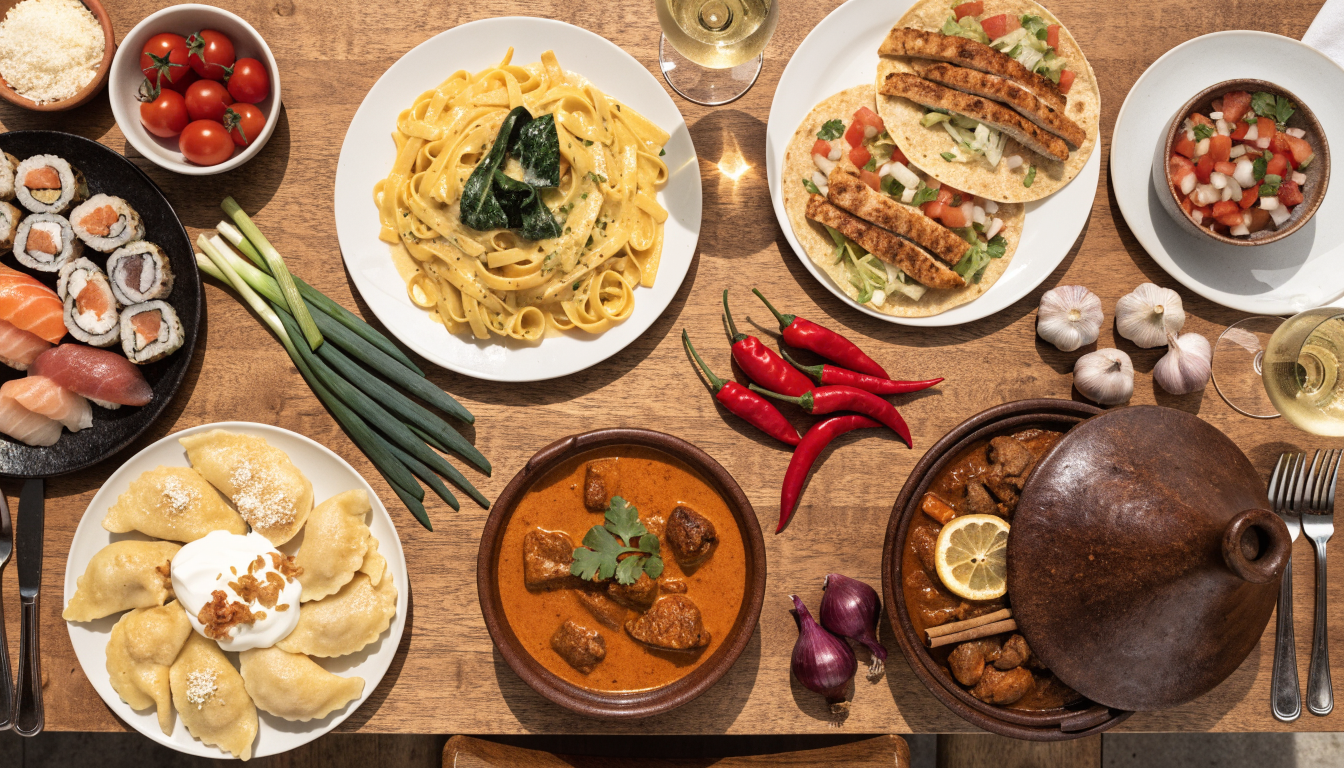
Line up enough national cuisines side by side and the differences start to look less like separate traditions and more like local dialects of the same conversation. Every one of them is answering the same handful of questions with whatever was on hand: how do you keep food edible without refrigeration, how do you season a dish without wasting anything, and how do you make a small amount of meat or dairy feed a whole table. Polish fermentation, Georgian walnut sauces, and Thai balance of sour, salty, sweet, and spicy are different answers to problems every kitchen on earth has faced.
Here's the thing about world cuisine, and it's that people treat it like a shopping list problem: buy the right spice, own the right pan, and you've cooked Thai food or Polish food. That's backwards. Every cuisine here is really solving the same three problems: how to preserve food, how to build seasoning instead of sprinkling it on, and how to stretch a small amount of protein across a full meal. Learn which problem a cuisine is solving and the specific dishes stop looking like a memorization exercise and start looking like variations on a method.
The second thing worth knowing before you start: this pantry is cheaper than it looks. Fermented pastes, dried chiles, and aromatics keep for months and get reused across a dozen dishes within the same country's hub, so the up front cost of stocking a new cuisine's pantry pays off fast once you're cooking more than one recipe from it. The only real expense is patience: fermentation, long braises, and dried spice blooming all ask for time, not money.
Start anywhere. If world cuisine feels intimidating, Italian Recipes and Mexican Recipes are the two hubs I'd begin with, because both lean on ingredients already common in most American kitchens, so you're learning a new technique rather than sourcing a whole new pantry at the same time.
Europe
European technique tends to run on restraint or patience rather than heavy seasoning, and the differences between these hubs are mostly about which one they lean on.


The Middle East, the Caucasus, and Asia
These hubs share a reliance on layered spice and fermentation built up in stages, rather than one seasoning blend stirred in at the end.


The Americas
These hubs are younger fusions in most cases, built from indigenous ingredients meeting colonial and immigrant technique, and the results rarely look like one single lineage.


The Part Nobody Tells You About Cooking World Cuisine at Home
This applies to almost every hub on this page, so it lives here rather than being repeated on every single one of them.
Buy the technique, not the exotic ingredient. Most failed attempts at an unfamiliar cuisine come from sourcing the right fish sauce or the right paprika and skipping the actual technique, the fermentation, the spice blooming, the toasting, that the ingredient depends on to taste right.
One good knife and one heavy pot cover almost everything here. The specialty equipment lists for most of these cuisines are short. What actually varies is technique and timing, not gear.
Substitution is normal, not cheating. Most of these dishes were built by home cooks adapting to whatever was available that season or that year. Swapping a vegetable or a cut of meat for something local is closer to the tradition than treating the recipe as fixed.
Read the whole hub before you shop. A single fermented paste or dried chile often shows up across four or five dishes within the same country's hub. Buying it once and using it repeatedly is cheaper than buying a new specialty item for every single recipe.
Where This Fits on the Site
World cuisine sits alongside the site's other recipe collections rather than replacing them, and a lot of the technique here echoes what's covered elsewhere.
- The Five Mother Sauces, the French technique underneath a lot of what shows up in the France and Italy hubs
- Marinade Recipes, several of which are already built from the same countries covered here
- The Butchery Guides, for the protein decisions made before any of these recipes start
- Pots, Pans, and Cookware, the heavy pot most of these braises and stews depend on
- The full recipe index, everything on the site in one place
More Recipe Guides
Looking for something else? The full recipe index has everything on the site in one place.
- Full Recipe Index
- Soup and Chowder Recipes
- Salad Recipes
- Appetizers
- Breakfast Recipes
- 15-Minute Snacks
Who Is Writing This
I'm Chef Alan. I have spent 35 years in professional kitchens, I have formal culinary education in New Hampshire, and I have been honored as a 6-Time 4-Diamond Chef. More about me here.
If a recipe is missing something you needed, or a step didn't make sense, tell me. Get in touch and I'll fix it.
Cook Bolder, Serve Wiser, Eat Better.
Tools for the Job
Almost nothing on this page needs specialty equipment beyond a sharp knife and a pot heavy enough to hold steady heat through a long braise or a slow fermentation.