

Choose a blender when your kitchen life runs on liquids: smoothies, soups, sauces, crushed ice. Choose a food processor when it runs on solids: chopping, shredding, dough, thick dips like hummus. If you make both kinds of food regularly and you’ve got the counter space, owning both solves more problems than any single “do it all” gadget ever will.
TL;DR:
- A blender excels at crushing ice, making smoothies, and pureeing soups due to its vortex design and high-speed motor, but struggles with dense, tacky, or solid foods like dough or cheese.
- Food processors are best for chopping vegetables, slicing, shredding, kneading dough, and ricing potatoes, thanks to their wide bowls and interchangeable blades, but are not suited for ultra-smooth liquids.
- For daily use with frozen fruit or ice, invest in a high-wattage blender with a tamper to prevent strain and stallout; low-powered models will likely burn out quickly.
- Occasional cooks can opt for entry-level models ($40 to $80), but heavy users should prioritize higher-performance appliances with strong torque or wattage for durability and efficiency.
- Combination units save space but typically do not match the performance of dedicated appliances, making them less ideal for heavy-duty or precision tasks.
Table of Contents
- Blender vs Food Processor: A Quick Comparison
- What a Blender Actually Does Well
- What a Food Processor Actually Does Well
- How to Choose: A Checklist for Your Kitchen
- Combo Units, Attachments, and Immersion Blenders
- The Bottom Line on Blenders vs Food Processors
- A Home Cook’s Honest Take on This Trade-Off
- Ready to Add the Right Appliance to Your Kitchen?
- Sources
- FAQ
Blender vs Food Processor: A Quick Comparison
Matching the task to the tool takes the guesswork out of this decision. Here’s how the most common kitchen jobs sort themselves out:
- Smoothies and frozen drinks: blender
- Silky soups and purees: blender
- Vinaigrettes and thin sauces: blender
- Pesto and coarse dips: food processor (or blender in a pinch)
- Hummus and nut butter: food processor
- Shredding cheese or vegetables: food processor
- Slicing potatoes or cucumbers: food processor
- Pie dough and pastry: food processor
- Crushing ice: blender, no contest
The pattern comes down to geometry and power. A blender’s narrow jar and angled blades pull ingredients into a tight vortex, which is exactly why it turns ice and frozen fruit into something drinkable while a food processor’s flat, wide bowl just pushes cubes around. Consumer Reports’ testing confirms ice can actually damage some food processor bowls and blades, so keep the frozen stuff in the blender’s lane.
What a Blender Actually Does Well
A blender’s whole design revolves around that vortex. The jar tapers, the blades sit at an angle near the bottom, and the motor spins fast enough to keep pulling ingredients down into the blades over and over. That repetition is why blended soups come out velvety instead of chunky, and it’s the mechanical reason Serious Eats points to when explaining why blenders and food processors produce such different results from the same ingredients.
Blenders earn their counter space with:
- Smoothies and protein shakes
- Silky bisques and pureed soups
- Salad dressings and thin sauces
- Homemade nut milk
- Crushed ice and frozen cocktails
When you’re shopping, look past the marketing and check motor wattage, whether a tamper is included (for thick smoothies that stall the blades), jar material (glass resists scratching better than plastic), the number of real speed settings, and warranty length.
Pro Tip: If frozen fruit is a daily habit, don’t settle for an entry-level motor. An underpowered blender will strain, stall, and eventually burn out trying to do a job it was never built for.
Where blenders fall short: shredding, slicing, and anything tacky or dense, like thick cookie dough. Ask a blender to grate cheese and you’ll get a mess, not a topping.
What a Food Processor Actually Does Well
Swap the vortex for an S-shaped blade spinning fast and flat inside a wide, shallow bowl, and you get a completely different tool. The pulse function lets you control texture in short bursts instead of running the motor continuously, which is exactly what keeps chopped onions from turning into onion soup. That wide bowl and interchangeable disc system are what let a food processor chop, shred, slice, and knead with a precision blenders can’t match.
Food processors handle:
- Chopping vegetables and herbs in seconds
- Shredding cheese, carrots, or cabbage
- Slicing potatoes or cucumbers evenly
- Making pizza and pastry dough
- Ricing potatoes or cauliflower
- Coarse purees like hummus and pesto
Before buying, weigh bowl capacity against your typical batch size, check what discs and blades come standard, and pay attention to motor torque rather than raw wattage. Torque is what keeps the blade from choking on a dense block of parmesan or a stiff dough ball.
The catch: food processors aren’t built for ultra-smooth liquids, and a bowl filled too close to the top with soup or sauce can leak around the lid.
How to Choose: A Checklist for Your Kitchen
Skip the spec-sheet rabbit hole and work through this instead:
- List your top three most-cooked items. If smoothies, soups, or cocktails dominate, lean blender. If chopping, shredding, or dough shows up more, lean food processor.
- Estimate weekly use. Daily use justifies spending more on motor power and build quality; occasional use doesn’t.
- Check your storage space. A full-size food processor with three or four discs takes up more cabinet real estate than most people expect.
- Match your budget to your habits. Entry-level blenders and processors (roughly $40 to $80) handle light, occasional use fine. Daily users doing frozen fruit, ice, or dense dough should budget for higher-performance models, since Serious Eats and other testers consistently find underpowered machines overheat or stall under regular pressure.
- Ask three questions before checkout: What’s the actual motor wattage or torque rating? Are the bowl, jar, and blades dishwasher-safe? Can you buy replacement blades or gaskets later, and how long is the warranty?
Pro Tip: Don’t buy the cheapest blender you can find if frozen fruit is part of your daily routine. A weak motor paired with ice, every single morning, is the fastest way to end up buying a second blender within a year.
If your household leans hard toward batch cooking and baking, Wirecutter’s guidance backs up prioritizing a food processor’s capacity and discs. If smoothies and soups dominate, put your money into the blender first.
Combo Units, Attachments, and Immersion Blenders
Combination units that pair a blender jar with a food processor bowl on one motor base do exist, and they save real counter and cabinet space. The trade-off, according to Consumer Reports’ testing, is that combo appliances rarely match the peak performance of two dedicated machines. You’re buying convenience, not top-tier results.
- Combo systems, like Wine Drop Cookery’s multi-blend kitchen system, suit smaller kitchens or lighter use better than daily heavy-duty prep.
- Immersion blenders excel at small-batch soups, sauces, and simple emulsions right in the pot, cutting down on dishes.
- What immersion blenders can’t do: shred, slice, or knead. Bon Appétit’s coverage is clear that they’re a liquid-task specialist, not a stand-in for a processor.
The Bottom Line on Blenders vs Food Processors
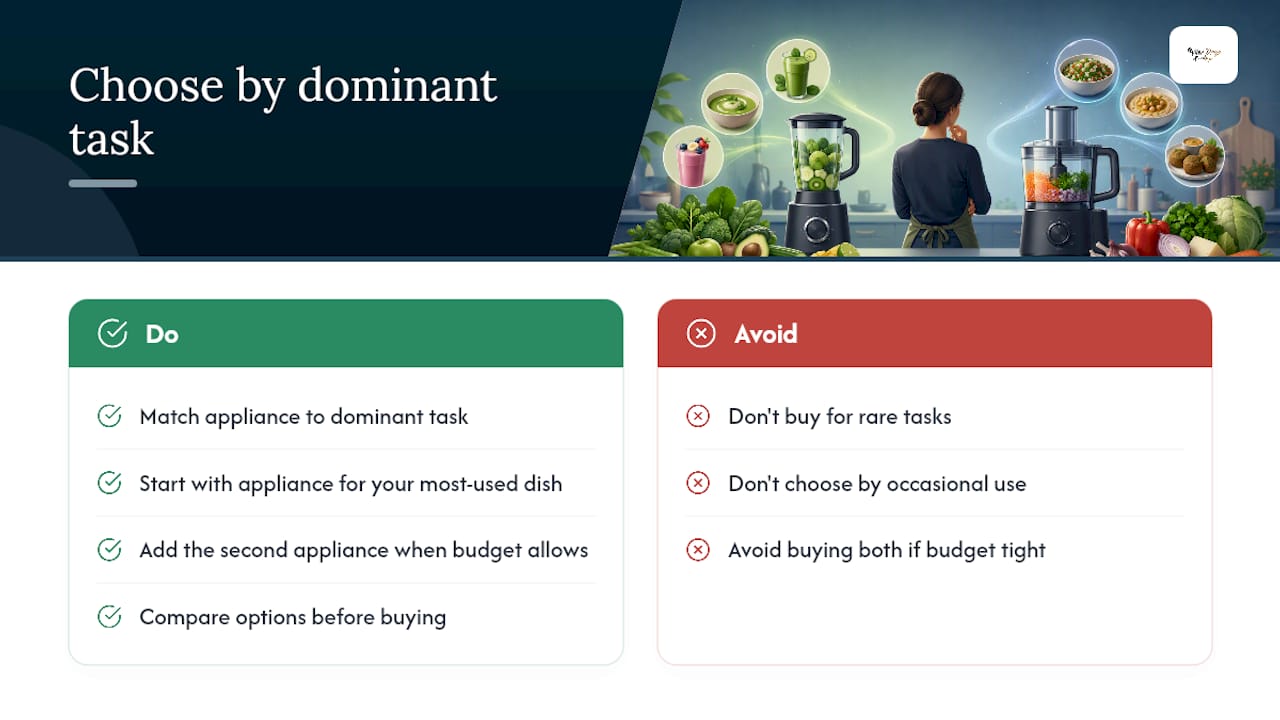
Match the appliance to your dominant task, not the one you use twice a year. Still torn? Start with whichever machine covers your most frequent job, then add the second appliance once budget allows. Ready to compare options? Browse Wine Drop Cookery’s blender picks built for exactly this kind of decision.
A Home Cook’s Honest Take on This Trade-Off
The biggest regret I see isn’t picking the wrong appliance. It’s picking an underpowered one to save $20 and then fighting it every single day. Prioritize motor power if smoothies are a daily habit. Prioritize bowl capacity if you’re prepping for a crowd. Skip whatever doesn’t match how you actually cook.
Alan
Ready to Add the Right Appliance to Your Kitchen?
Our curated selection skips the guesswork of comparing a dozen near-identical listings elsewhere. Each appliance is chosen for a specific job, whether that’s a daily-driver blender for smoothies or a full-capacity processor for weekend batch cooking, so you’re not stuck reading spec sheets to figure out which one actually fits your habits.
If liquids dominate your kitchen, our smoothie blender guide points you toward the right motor power for daily frozen fruit and ice. If chopping and shredding are more your speed, the multi-blender kitchen system and its 3-cup food processor bowl handle chopping, slicing, and shredding. Tight on counter space? The immersion blender covers soups and emulsions without eating a cabinet shelf. Planning a big holiday cooking session? These meal-prep tips for busy home cooks pair well with a food processor’s batch-prep speed. Browse our full kitchen essentials collection and pick the appliance that matches how you actually cook.
Sources
For deeper testing details, Consumer Reports covers appliance durability, Wirecutter covers habit-based buying advice, Bon Appétit covers chef-tested texture differences, and Serious Eats breaks down the mechanics behind both appliances.
- Face-Off: Blender vs. Food Processor - Consumer Reports
- Do You Need a Food Processor, a Blender, or Both? Here’s How to Figure It Out. | Reviews by Wirecutter
- Food Processor vs. Blender: Do You Really Need Both? | Bon Appétit
- Food Processor vs. Blender: What’s the Difference? | Serious Eats
FAQ
Can a Regular Blender Be Used as a Food Processor?
A blender can chop softer ingredients in a pinch, but it struggles with shredding, slicing, and dense doughs because it lacks the wide bowl and disc attachments a food processor uses for those jobs.
Do You Need Both a Blender and a Food Processor?
Not necessarily. If your cooking leans heavily toward one category, liquids or solids, one well-chosen appliance covers most of your needs; owning both simply removes the compromise if you have the space and budget.
What Can a Food Processor Do That a Blender Cannot?
A food processor shreds cheese and vegetables, slices produce evenly, kneads dough, and rices potatoes, tasks that require a wide bowl and interchangeable blades rather than a tapered jar.
What Are the Cons of Using a Blender as a Processor?
Beyond weak chopping and shredding results, forcing a blender to handle thick or dry mixes can stall the motor and leave you with uneven, mushy textures instead of clean cuts.
0 comments