

To air fry is to cook food in a compact countertop appliance that blasts hot air around it at high speed, crisping the surface with little or no oil. If you’re wondering whether it’s worth buying one, the short answer is yes — for most home cooks who make small batches regularly. The Wine Drop Cookery 12L Air Fryer is the publisher’s recommended pick for households that want a larger usable surface without a complicated digital interface. The single best buying rule: choose the largest usable basket width you can comfortably store.
Quick pros:
- Uses tablespoons of oil instead of quarts
- Cooks small batches faster than a full-sized oven
- Excellent for reheating and frozen foods
Quick cons:
- Basket size limits batch cooking
- Wet-battered foods rarely crisp well
- Takes up permanent counter space
Pro Tip: Before buying, measure the footprint on your counter. An air fryer you have to store in a cabinet rarely gets used.
Key Takeaways
An air fryer is a compact convection appliance that crisps food with little oil; usable basket width, consistent airflow, and easy cleaning are the three features that determine whether a model is worth buying.
| Point | Details |
|---|---|
| What “air fry” means | A countertop convection appliance circulates hot air to crisp food with minimal oil. |
| Top buying priority | Usable basket width matters more than stated quart capacity for single-layer cooking. |
| Main trade-off | Crowding the basket causes steaming; batch size is limited by the cooking surface. |
| Oil and time savings | Air fryers use tablespoons of oil vs. quarts in deep frying and save 5–10 minutes on small batches. |
| Wine Drop Cookery 12L | The publisher’s recommended pick for families of 3–5 who want a wide basket and simple dual-knob controls. |
Table of Contents
- How does an air fryer actually cook food?
- What air fryers do well and where they fall short
- What style of air fryer should you choose?
- How to choose the right air fryer for your kitchen
- The best air fryers to consider in 2026
- Air fry cooking times and practical tips for common foods
- Cleaning, smoke prevention, and safe use
- How we tested and what actually matters
- Do you actually need an air fryer?
- An editor’s honest take on daily air fryer use
- Wine Drop Cookery 12L Air Fryer: the publisher’s recommended pick
- Sources
- FAQ
How does an air fryer actually cook food?
An air fryer works by combining a heating element with a powerful fan inside a compact chamber, driving hot air downward and around the food at high velocity. That concentrated airflow is what makes it behave like a small convection oven, not a fryer in the traditional sense. The term “air fry” is really a marketing label for fast, directed convection cooking.
Here’s the airflow path in simple terms:
- The heating element at the top of the unit heats air rapidly.
- The fan forces that hot air downward through the basket.
- Air circulates through the basket’s perforations and around the food.
- Moisture evaporates quickly from the food’s surface, creating a crisp crust.
- Spent air exits through vents, and the cycle repeats continuously.
The perforated basket is doing real work here. It lets air hit the food from below as well as above, which is why single-layer cooking matters so much. Stack food two layers deep and the bottom layer steams instead of crisps.
Preheating is often optional or very short because the chamber is small. A full-sized oven needs longer to stabilize; an air fryer reaches temperature in a fraction of that time, which is where the speed advantage comes from.
Pro Tip: Never fill the basket more than halfway. Crowding forces the appliance to work harder and turns what should be a crisp result into a soggy one.
What air fryers do well and where they fall short
Air fryers genuinely reduce oil use and speed up small-batch cooking. They don’t replicate deep-fried texture for everything, and that’s worth knowing before you buy.
According to America’s Test Kitchen, air fryers use tablespoons of oil where deep frying requires quarts, and they can shave 5–10 minutes off many recipes compared to a full-sized oven for small batches.
Practical benefits:
- Significantly less oil than deep frying for similar crispness on fries, wings, and nuggets
- Faster preheat and cook times for portions of 1–4 servings
- Reheats leftovers (pizza, fries, spring rolls) far better than a microwave
- Consistent results for frozen foods right out of the bag
Real trade-offs:
- Crowding the basket causes steaming, not crisping — airflow is the mechanism
- Wet-battered foods (beer batter, tempura) often blow off or cook unevenly
- Lean proteins like chicken breast can dry out without a light oil coating
- Batch size is limited; cooking for six or more people means multiple rounds
Oil use at a glance: A tablespoon of oil on a tray of fries versus a quart or more in a deep fryer. For everyday cooking, that difference adds up quickly.
One concern worth noting: some air fryer baskets use nonstick coatings that may contain PFAS (per- and polyfluoroalkyl substances). If that matters to you, look specifically for models marketed as PFAS-free or ceramic-coated. Wine Drop Cookery’s self-cleaning, non-toxic air fryer variant addresses this directly.
What style of air fryer should you choose?
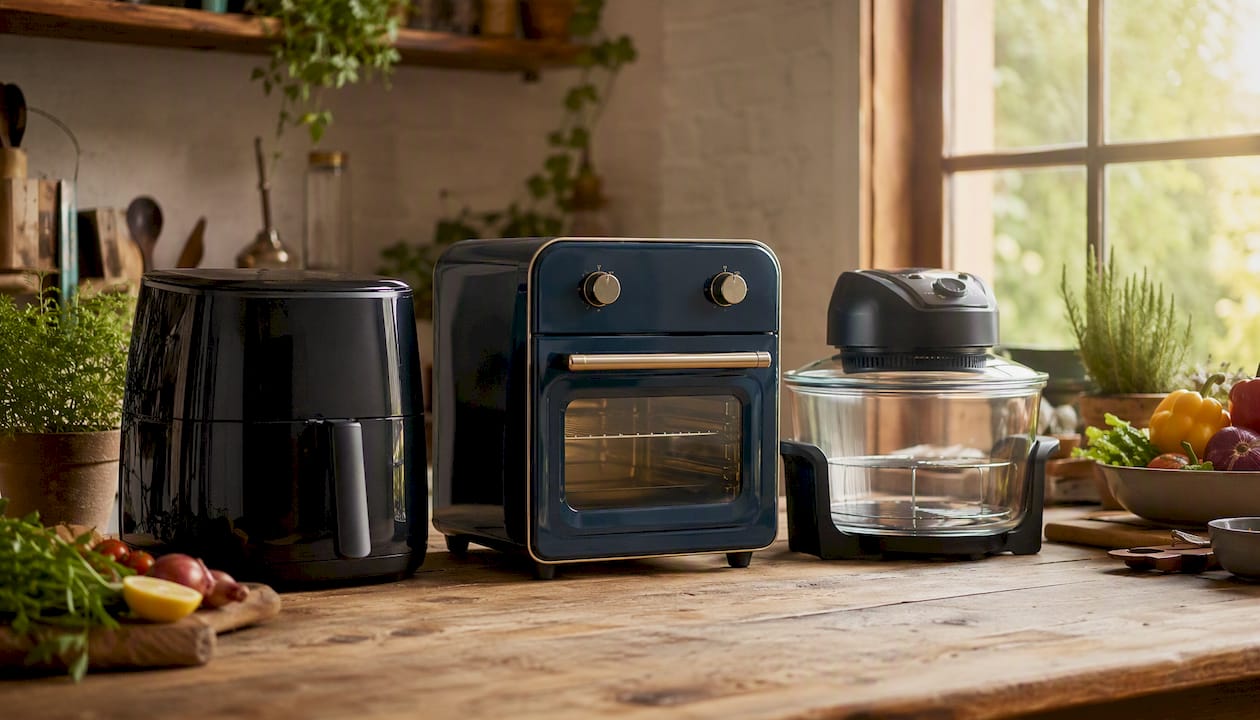
The three main styles are basket/drawer units, oven/toaster-oven hybrids, and glass-bowl models. Your choice should start with usable cooking surface width, not the quart number on the box. A tall, narrow 6-quart basket can hold less food in a single layer than a wide, shallow 5-quart one.
| Capacity | Typical usable surface | Household size | Best style |
|---|---|---|---|
| 2–3 quarts | ~7 inches wide | 1 person | Basket/drawer |
| 4–5 quarts | ~8 inches wide | 2 people | Basket/drawer |
| 6 quarts | ~10 inches wide | 2–4 people | Basket or compact oven |
| 10+ quarts / 12L | ~11 inches wide | 4–6 people | Oven-style or large basket |
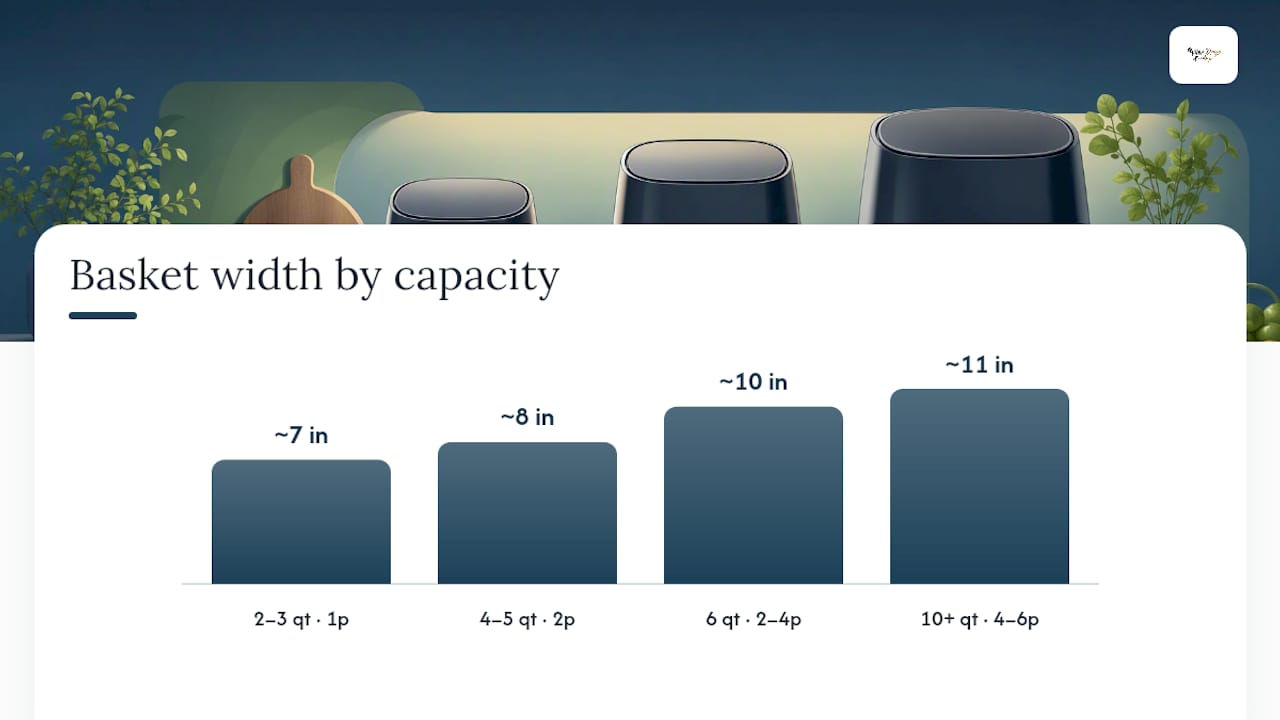
America’s Test Kitchen’s testing consistently finds that usable basket width matters more than stated capacity because food cooks best in a single layer. A wide, shallow basket lets you shake food easily mid-cook and gives hot air more surface area to work with.
Basket/drawer units are easier to clean and suited to small batches. Oven-style units offer multi-rack cooking, dehydration, and toasting in one appliance but occupy more counter space and require more cleaning effort. Glass-bowl models are less common in the U.S. market and offer limited advantages over the other two styles for most home cooks.
Pro Tip: Lay out your usual batch of chicken wings or fries on a baking sheet before buying. Measure that footprint — that’s the minimum basket width you need for one-layer cooking.
How to choose the right air fryer for your kitchen
The features that actually affect your results are usable cooking surface, consistent airflow, reliable temperature control, and easy cleaning. Everything else is secondary.
Buying checklist:
- Usable basket dimensions — measure width and depth, not just quart capacity.
- Temperature range — most models top out at 400–450°F; models with 5-degree increments are easier to use for recipe conversion.
- Control type — digital controls with presets suit tech-comfortable cooks; dual knobs suit anyone who wants to set it and walk away.
- Wattage — 1,500–1,800W is standard; lower wattage can mean slower cooking.
- Cleanup — dishwasher-safe baskets and removable crumb trays save real time.
- Build materials — ceramic or PFAS-free coatings are worth seeking out.
- Warranty — at least one year from a brand with U.S. customer support.
Questions worth asking before you buy:
- Does it offer 5-degree temperature increments?
- Is the interior coating ceramic or explicitly PFAS-free?
- Are the basket and crumb tray dishwasher-safe?
Red flags to avoid:
- Thin, flimsy baskets that flex when loaded
- No removable crumb tray
- Temperature steps of 25 degrees only (makes precise recipe conversion difficult)
- Vague or no warranty information
Some models add viewing windows (like the Instant Pot Vortex Plus 6-Quart ClearCook) and odor-filtering technology. These are genuinely useful for monitoring browning without opening the basket, but they don’t affect crispness. Treat them as convenience features, not performance indicators.
Pro Tip: Digital controls with preset buttons are convenient, but they can lock you into fixed temperatures. If you adapt recipes often, a model with manual temperature adjustment in small increments gives you more control.
The best air fryers to consider in 2026
These models appear repeatedly in 2026 testing across major review outlets. The Wine Drop Cookery 12L Air Fryer leads as the publisher’s recommended pick. Disclosure: Wine Drop Cookery sells the 12L model featured first; it’s included because it fits the criteria this guide prioritizes — usable surface, simple controls, and non-toxic materials.
How to read this list: match the “best for” note to your household size and cooking habits, then check whether the form factor fits your counter.
-
Wine Drop Cookery 12L Air Fryer (Dual Knob Control) — Best for families of 3–5 who want a wide usable basket and straightforward dual-knob controls. The 12-liter capacity gives you real room for a full tray of wings or a generous batch of fries without multiple rounds. Non-toxic interior variants are available directly from the publisher.
-
Cosori Turboblaze 6.0-Quart Smart Air Fryer — A consistently top-ranked mid-range pick for weekly family cooking. Multiple presets, reliable crisping, and a price point that makes it one of the most recommended models in comparative 2026 reviews.
-
Cosori Iconic Stainless Steel 6.5-Quart Smart Air Fryer — The stainless exterior appeals to cooks who want a cleaner look on the counter. Smart controls and a slightly larger basket than the Turboblaze make it a step up for households cooking for four regularly.
-
Cosori Lite 2.1-Quart Mini — The right call for a single-person household or a very small kitchen. It handles snacks and single servings well; don’t expect it to cook a full chicken breast without crowding.
-
Breville Smart Oven Air Fryer Pro — The best choice if you want one appliance to replace your toaster oven entirely. It air fries, bakes, roasts, and dehydrates across multiple racks. The footprint is substantial, so measure your counter first.
-
Breville Smart Oven Air Fryer Compact — Same Breville versatility in a smaller footprint. A good fit for cooks who want toaster-oven functionality but can’t accommodate the Pro’s size.
-
Philips Premium Digital Air Fryer — Philips pioneered the consumer air fryer category, and this model reflects that engineering history. Straightforward digital controls and stable performance across repeated tests.
-
Cuisinart 6-qt Basket Air Fryer — A dependable mid-range basket unit from a brand most U.S. home cooks already trust. Solid build, predictable results, and widely available for service and parts.
-
Instant Pot Vortex Plus 6-Quart ClearCook — The viewing window and interior light let you check browning without opening the basket, which is genuinely useful for delicate foods. Simple controls and a familiar brand make it approachable for first-time buyers.
-
Ninja Crispi / Ninja Air Fryer Max XL — Ninja’s lineup covers a wide range of sizes and price points. The Max XL’s larger basket suits households that cook for four or more; the Crispi’s modular design suits cooks who want portability.
-
Instant Vortex Plus — A reliable, no-frills basket air fryer from Instant with consistent airflow and easy cleanup. A practical choice for buyers who want proven performance without premium pricing.
Pro Tip: If you’re torn between two models at similar price points, choose the one with the wider basket. You can always cook a smaller batch in a large basket; you can’t cook a larger batch in a small one.
Air fry cooking times and practical tips for common foods
Most air fryer recipes follow a simple pattern: coat lightly with oil, cook in a single layer, shake or flip halfway through. Recipe testing across major food publications confirms that frozen foods, roasted vegetables, and snacks like wings and fries are where air fryers perform most consistently.
| Food | Temp | Time | Preheat? | Technique tip |
|---|---|---|---|---|
| Frozen fries | 400°F | 14–18 min | Optional | Shake halfway through for even browning |
| Chicken wings | 400°F | 22–26 min | Yes (3 min) | Pat dry before cooking; flip at halfway |
| Chicken breast | 375°F | 16–20 min | Yes (3 min) | Brush with oil to prevent dryness |
| Chicken thighs | 400°F | 20 min | Optional | Skin-side up; no need to flip |
| Frozen nuggets | 400°F | 10–12 min | No | Single layer only |
| Fish fillets | 375°F | 10–14 min | Yes (3 min) | Light oil coat; avoid wet batter |
| Broccoli/vegetables | 375°F | 10–14 min | No | Toss in oil; shake once mid-cook |
Technique tips for better results:
- A light spray or brush of oil on the food (not the basket) helps browning without adding significant calories.
- For lean proteins, a thin coating of oil prevents the surface from drying out before the interior cooks through.
- To convert an oven recipe, reduce the temperature by 25°F and start checking 5 minutes early. Published recipe tests recommend adjusting oil amounts down as well, since the smaller chamber concentrates heat more than a full oven.
- For crispier results on vegetables, pat them dry before tossing in oil. Moisture is the enemy of crispness.
Quick stat: Air fryers can cut cook time by 5–10 minutes on many small-batch recipes compared to a full-sized oven, according to America’s Test Kitchen.
Safety note: Steam escapes when you pull the basket out. Always open it away from your face, and use silicone-tipped tongs rather than bare hands to handle food. The basket and drawer get very hot; set them on a heat-safe surface, not directly on a countertop.
For a deeper collection of tested recipes, Wine Drop Cookery’s 150+ Easy Air Fryer Recipes digital cookbook covers everything from weeknight dinners to snacks.
Cleaning, smoke prevention, and safe use
Clean the basket and crumb tray after every use. Grease buildup is the primary cause of smoke, and smoke is the primary cause of off-flavors in the next batch.
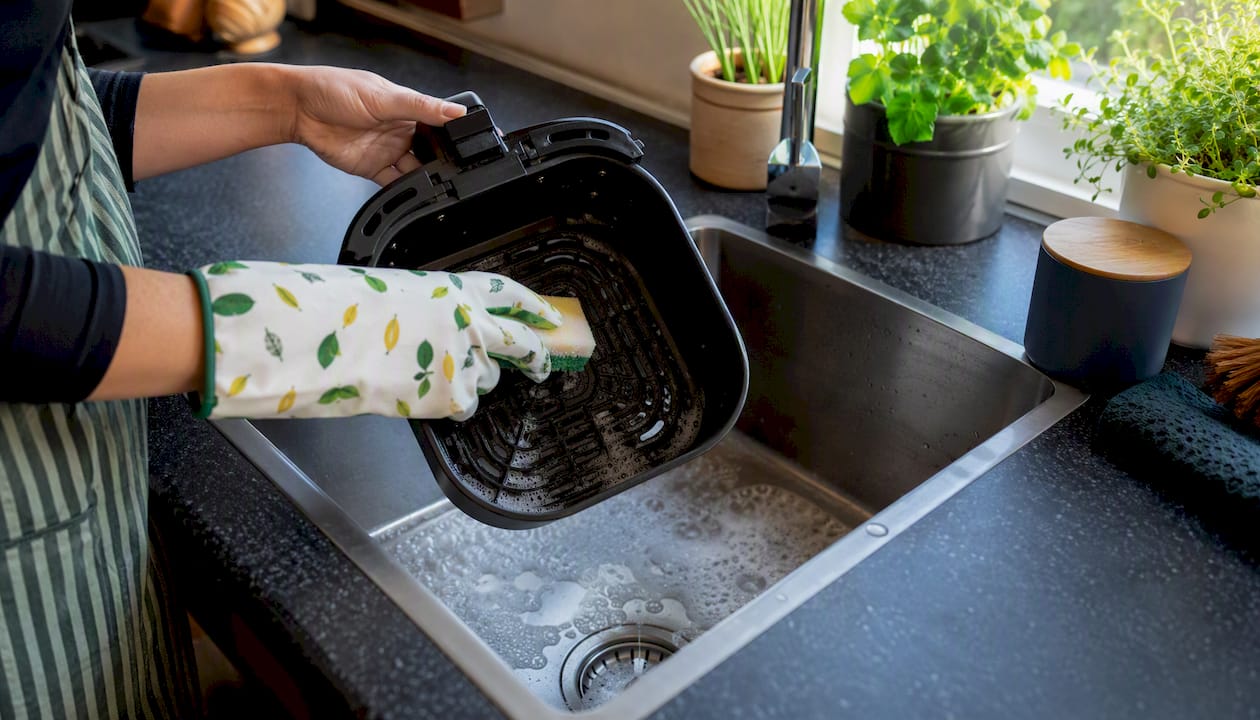
Most baskets are dishwasher-safe, but check your model’s manual before assuming. Hand-washing with warm soapy water and a soft sponge is the safest approach for nonstick-coated baskets. Never use steel wool, abrasive scrubbers, or aerosol cooking sprays directly on nonstick surfaces — aerosols contain propellants that degrade coatings over time. Use a pump-style oil mister instead.
If your air fryer smokes during cooking, the likely cause is fat dripping onto the heating element. Adding a tablespoon of water to the bottom drawer (below the basket) can catch drips and reduce smoke. Lowering the temperature by 25°F also helps with fatty cuts like bacon or skin-on thighs.
Maintenance checklist:
- Wipe the interior walls and heating element with a damp cloth weekly.
- Check the crumb tray after every fatty cook.
- Never submerge the main unit in water.
- Leave at least 5 inches of clearance behind and above the unit for ventilation.
Pro Tip: For stubborn grease on the basket, soak it in hot soapy water for 10 minutes before scrubbing. Most residue comes off without any real effort after a short soak.
One safety note: metal utensils scratch nonstick coatings and can introduce particles into food over time. Use silicone or wooden tools when handling food in the basket. For a set that works safely with nonstick surfaces, Wine Drop Cookery’s stainless steel utensil set includes nonstick-safe options.
How we tested and what actually matters
Testing priorities, in order: airflow consistency, usable basket area, temperature accuracy, and repeatable crispness across multiple cooks. A model that nails the first batch but fades by the third isn’t reliable enough to recommend.
Test methods included repeat cooks of frozen fries and chicken wings (the two most common air fryer foods), measuring actual usable basket surface with a ruler, timing preheat to temperature, and comparing crispness visually and by texture. Temperature accuracy was checked against an independent thermometer at multiple set points.
Rtings across dozens of models confirms what hands-on testing shows: extra-large and wide-basket designs consistently outperform taller, narrower baskets for single-layer cooking. Serious Eats adds that models with 5-degree temperature increments give cooks more precision for recipe conversion, a detail that matters more than it sounds when you’re adapting an oven recipe.
What made a model stand out:
- Consistent airflow that crisped food evenly from edge to edge, not just the center
- Basket width that matched or exceeded the stated capacity’s practical use
- Temperature that held steady rather than cycling wide around the set point
- Controls that were legible and responsive without a learning curve
Third-party testing from Bon Appétit’s 2026 air fryer coverage and The Kitchn was cross-referenced against hands-on results to confirm which models held up across different food types and cooking styles.
Do you actually need an air fryer?
It depends on how you cook. For a small household that makes snacks, reheats leftovers, and cooks small batches several times a week, an air fryer earns its counter space quickly. For a family that roasts a whole chicken once a week and rarely makes small batches, a convection oven already does the job.
Buy one if:
- You cook for 1–4 people and make small batches regularly.
- You reheat leftovers often and want better results than a microwave.
- You eat a lot of frozen foods and want them crispier than an oven produces.
- Counter space is available and you’ll use it at least three times a week.
Skip it (or wait) if:
- You already own a convection oven and use it regularly.
- You primarily cook large roasts or full sheet-pan dinners.
- Counter space is genuinely limited and you won’t keep it out permanently.
- You rarely cook small batches or snacks.
How to mimic air fryer results without one:
- Set your convection oven to 25°F higher than the recipe calls for.
- Use a wire rack on a sheet pan so air circulates under the food.
- Don’t crowd the pan — single layer only.
- Check 5 minutes earlier than the recipe suggests.
The Kitchn’s honest review puts it plainly: air fryers are convenient but not strictly necessary if you already have a convection oven. The real advantage is speed and the fact that a dedicated small appliance heats up faster and holds temperature more consistently for small batches.
Pro Tip: The air fryer earns its place most on weeknights when you need something crispy in under 20 minutes. If that scenario describes your cooking three or more times a week, it will pay for itself in convenience alone.
An editor’s honest take on daily air fryer use
The air fryer’s reputation as a health appliance is a little overstated. Where it genuinely shines is convenience. Reheated pizza comes out with a crisp crust instead of a soggy one. Roasted garlic takes 20 minutes instead of 45. A handful of frozen dumplings goes from freezer to plate in 12 minutes without heating up the whole kitchen.
What surprises most cooks is how often the air fryer becomes the default for small-batch meal prep. Portioning out roasted vegetables for the week, crisping up leftover rice, making a quick snack for one — these are the daily habits that make it worth the counter space. The models that get used most are the ones that stay out permanently, which is why size and simplicity of controls matter more than a long preset list.
Match the appliance to your actual routine. A 2-quart unit for a household of four will frustrate you. A 12-liter unit for one person is overkill. Get the size that fits your most common batch, keep it on the counter, and you’ll use it more than you expect.
Wine Drop Cookery 12L Air Fryer: the publisher’s recommended pick
The Wine Drop Cookery 12L Air Fryer with Dual Knob Control is the publisher’s in-category recommendation for home cooks who want a larger usable surface and a no-fuss control setup.
The 12-liter capacity offers a wide basket suitable for cooking full batches of wings, generous trays of fries, or whole small chickens without needing multiple rounds. Dual knob controls set temperature and time directly, with no app, no presets to scroll through, and no screen to learn. Non-toxic interior and self-cleaning variants are available from Wine Drop Cookery for cooks who prioritize PFAS-free materials.
Who it suits:
- Families of 3–5 who cook in batches and don’t want to run multiple cycles
- Cooks replacing a toaster oven who want more usable interior space
- Anyone who prefers physical knob controls over digital interfaces
- Buyers who want a non-toxic interior option from the same brand
Disclosure: Wine Drop Cookery publishes this guide and sells the 12L model. It’s recommended here because it fits the buying criteria this article prioritizes: wide usable surface, simple controls, and non-toxic material options. Warranty and return details are available on the product page.
Ready to cook? Browse the full range of kitchen essentials at Wine Drop Cookery and find the model that fits your kitchen and your cooking habits.
Sources
- The Best Air Fryers For Faster, Crispier Cooking (2026) | Bon Appétit
- The Best Air Fryers of 2026 | America’s Test Kitchen
- Serious Eats - Best air fryer coverage
- Rtings
- 86 Easy and Delicious Air Fryer Recipes You’ll Make on Repeat | The Kitchn
FAQ
What is air frying, exactly?
Air frying is cooking food in a compact countertop appliance that uses a powerful fan and heating element to circulate hot air at high speed, crisping the surface with little or no oil. It’s essentially a small, fast convection oven.
What are the downsides of air fryers?
The main downsides are limited batch size, the inability to cook wet-battered foods well, and the counter space they require. Overcrowding the basket causes steaming rather than crisping, so large households often need multiple cooking rounds.
What 5 foods should you not put in an air fryer?
Wet-battered foods (beer batter, tempura), leafy greens that blow around, large whole roasts that don’t fit in a single layer, cheese without a protective coating, and foods in paper or cardboard packaging all perform poorly or create safety issues in an air fryer.
How long do most foods take to air fry?
Most common foods take 10–26 minutes at 375–400°F. Frozen fries take 14–18 minutes, chicken wings 22–26 minutes, chicken breast 16–20 minutes, and vegetables 10–14 minutes. Shaking or flipping halfway through improves even browning.
Is an air fryer better than a convection oven?
For small batches and quick weeknight cooking, an air fryer heats up faster and delivers crispier results more conveniently. For large roasts or full sheet-pan dinners, a convection oven is more practical. If you already own a convection oven, the air fryer’s advantage is speed and dedicated small-batch convenience.
0 comments